Will AI replace surgeons?
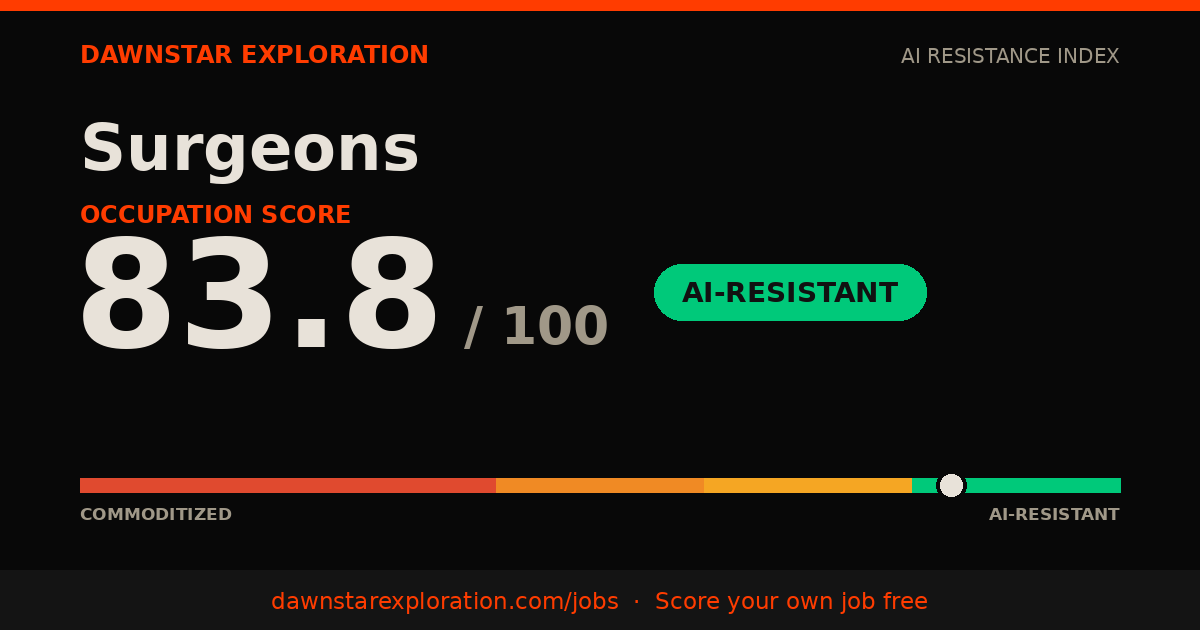
No, but it will change the week around the operation. Surgeons score 83.8/100 on the AI Resistance Index (AI-Resistant). The planning is exposed: reading scans, preparing for a case and writing up notes are tasks software already does well. The operation is not. A surgeon is licensed after years of training, works with their own hands on a patient who cannot be replaced by a screen, and carries personal liability for the outcome. Today's surgical robots are controlled by the surgeon rather than working in place of one.
Higher is safer. Scored on six structural dimensions, weighted as shown below.
How the score breaks down
Each dimension is rated 1 (AI holds every advantage) to 5 (strong structural protection). A rating's contribution is (rating − 1) ÷ 4 × weight, so a 1 contributes nothing and a 5 contributes the full weight.
| Dimension | Weight | Rating | Points |
|---|---|---|---|
| Automation Replaceability | 25% | 3 / 5 | 12.5 |
| Regulatory & Liability Friction | 20% | 5 / 5 | 20 |
| Human Judgment Density | 15% | 5 / 5 | 15 |
| Physical-World Coupling | 15% | 5 / 5 | 15 |
| Trust & Relationship Lock-In | 15% | 4 / 5 | 11.25 |
| AI Capital Intensity | 10% | 5 / 5 | 10 |
| Total | 100% | 83.8 |
Points are exact; the scoring engine rounds the total to one decimal.
Why each dimension scores the way it does
Rated 3. BLS describes surgeons as physicians who treat injuries, diseases and deformities by operating on patients, and the workload around that includes taking histories, reviewing results and charting. Software already drafts notes, reads images and helps plan cases, so the preparation and paperwork are exposed. The operation itself, and the decisions made mid-procedure when something does not look as expected, are not. That is why this rates 3 and not 2, the rating given to physicians as a whole.
Rated 5, the maximum. BLS reports that every state requires physicians and surgeons to be licensed, after graduating from an accredited medical school, completing a residency that lasts 3 to 9 years and passing national exams. Only a licensed surgeon may operate, and that surgeon is accountable for what happens in the room. Software cannot hold a licence, sign a consent form or be sued for a complication.
Rated 5, the maximum. A surgeon decides whether to operate at all, which approach to use and when to change plan because the anatomy is not what the scan showed. Those decisions are made under time pressure with a life at stake, and they involve weighing risks that the patient has to be able to understand and accept. There is no routine version of this that follows a checklist.
Rated 5, the maximum. Surgery cannot be done remotely or in software: it needs hands, instruments and a patient on a table in a room. Even when a robot is used, a surgeon sits at the console directing every movement. Nothing about the physical work reduces to a message, a document or a screen, so this dimension offers the most protection.
Rated 4. Patients choose a surgeon, often on a referral, and put their body in that person's hands, which is as strong a trust bond as work gets. It sits one point below the maximum because many operations are one-off: the patient may never see the surgeon again after recovery, so there is less repeat custom than in a profession with an ongoing client relationship.
Rated 5, the maximum. Replacing a surgeon would need a machine that can operate autonomously on different patients and handle surprises safely, followed by clinical trials, regulatory approval for each procedure and a company willing to accept the liability. That takes years and very large sums, which makes it the most expensive kind of work to automate, and the cost protects the profession.
Which parts of a surgeon's work AI takes first
BLS lists what physicians and surgeons typically do. Sorted by exposure:
Most exposed to AI
- Documenting findings and updating patient charts
- Reviewing test results and scans for abnormal findings
- Planning a case and choosing among treatment options
- Answering routine follow-up questions from patients
Most durable
- Operating on the patient
- Deciding mid-operation when the plan must change
- Getting informed consent and explaining the risks
- Answering personally for the outcome
The labor market today
| Median annual pay, physicians and surgeons (May 2025) | $275,930 |
| Jobs, physicians and surgeons (2025) | 862,800 |
| Projected change, 2025–35 | 4% (about as fast as average) |
| Openings per year, on average | ≈22,100 |
BLS does not publish separate figures for surgeons. It groups them with physicians, projects that group to grow 4% from 2025 to 2035, and expects about 22,100 openings a year. It attributes demand to a growing number of older adults and rising rates of chronic illness. Its outlook does not mention AI.
The pay and job figures on this page cover all physicians and surgeons, so they describe the wider profession and not surgery alone. Surgeons sit above physicians as a whole on this index because the operation itself is hands-on work, while much of a general physician's day is information work.
How to raise your resistance
- Let AI do the preparation. Charting, scan review and case planning are the parts software does best. Surgeons who hand them over spend more of the day on the operation and on talking to patients, which is the part that protects the work.
- Master the robotic and image-guided tools. The surgeon directs today's robots and imaging systems. Knowing how to use them well, and when to override them, keeps the surgeon in command of the technology.
- Own the decision and the consent. Deciding whether to operate and explaining the risks to the patient are judgment and trust work that AI can inform but cannot sign for.
- Build a reputation in a specialty. Referrals follow a surgeon's record in a particular procedure. A strong outcome record in a niche is hard for any competitor, human or machine, to copy quickly.
This score rates the occupation as a whole. Your exposure depends on what you actually do all day. The free Job Safety score asks about your specific role and day-to-day work, then rates your role on the same six dimensions in about a minute.
Score my job — freeQuestions people ask
Will AI replace surgeons?
No. AI is taking over scan review, case planning and charting, but only a licensed surgeon may operate, and the surgeon is liable for the result. Surgical robots today are controlled by the surgeon. BLS projects 4% growth for physicians and surgeons from 2025 to 2035.
Why do surgeons score higher than doctors on this index?
A surgeon's work centres on a hands-on operation, while a large share of a general physician's day is taking histories, reading results and charting, which AI does well. Both are licensed and liable for outcomes, and both rate at the maximum on regulation and judgment.
Can a robot perform surgery on its own?
Not safely across different patients today. Robotic systems used in operating rooms are directed by a surgeon, and fully autonomous surgery would need extensive trials, regulatory approval and a party willing to accept liability. That cost and approval burden is why AI capital intensity rates 5 here.
Use this score on your site
Writing about this job and AI? You're welcome to show this score card. Copy the code below: it displays the card and credits the source.
Compare with
Sources and method
Ratings are Dawnstar Exploration's structural assessment using the six-dimension AI Resistance Index framework; labor-market figures are quoted from the sources above as published. This page describes an occupation, not any individual.