Will AI replace registered nurses?
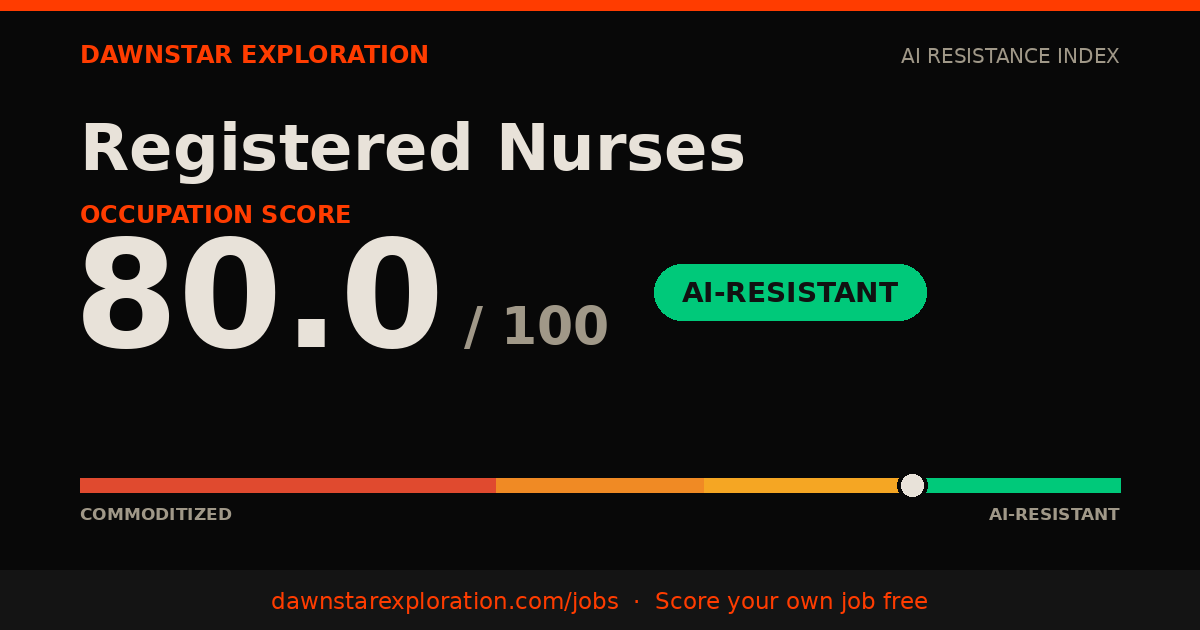
No, but it will change the shift. Registered nurses score 80.0/100 on the AI Resistance Index (AI-Resistant). The paperwork around nursing is exposed: charting, monitoring and writing up care plans are tasks software already handles well. The core of the job is not. A registered nurse is licensed by the state, assesses a patient in person, gives medicines and treatments with their own hands, and decides when something has changed and someone must act. The licence, the liability and the physical work are what hold the profession up.
Higher is safer. Scored on six structural dimensions, weighted as shown below.
How the score breaks down
Each dimension is rated 1 (AI holds every advantage) to 5 (strong structural protection). A rating's contribution is (rating − 1) ÷ 4 × weight, so a 1 contributes nothing and a 5 contributes the full weight.
| Dimension | Weight | Rating | Points |
|---|---|---|---|
| Automation Replaceability | 25% | 4 / 5 | 18.75 |
| Regulatory & Liability Friction | 20% | 5 / 5 | 20 |
| Human Judgment Density | 15% | 4 / 5 | 11.25 |
| Physical-World Coupling | 15% | 5 / 5 | 15 |
| Trust & Relationship Lock-In | 15% | 3 / 5 | 7.5 |
| AI Capital Intensity | 10% | 4 / 5 | 7.5 |
| Total | 100% | 80.0 |
Points are exact; the scoring engine rounds the total to one decimal.
Why each dimension scores the way it does
Rated 4. BLS lists a registered nurse's duties as assessing patients, recording histories and symptoms, administering medicines and treatments, operating and monitoring medical equipment, and teaching patients and families. Charting and monitoring are the exposed parts: software already drafts notes and flags readings that are getting worse. Giving a medicine, dressing a wound, moving a patient and talking someone through a diagnosis are not, which is why this rates 4 and not lower.
Rated 5, the maximum. BLS reports that registered nurses must hold a nursing license issued by the state in which they work, which requires graduating from an approved nursing program and passing a qualifying exam, plus checks such as a criminal background check. Only a licensed nurse may administer medicines and treatments, and that nurse is accountable for errors. Software cannot hold a license or be disciplined by a state board of nursing.
Rated 4. BLS names critical thinking first among the qualities nurses need: assessing changes in a patient's condition and deciding when to take corrective action. A nurse often notices that a patient looks wrong before any number says so, and has to decide whether to wait, call the doctor or start an emergency response. Much of the day follows protocols, which keeps this one point below the maximum.
Rated 5, the maximum. BLS notes that nurses may spend a lot of time walking, bending, stretching and standing, and that lifting patients is part of the work. Taking a pulse, starting an IV, turning a patient and responding to an emergency all need hands and presence in the room. Robots that could do this safely across different patients and different beds are far from practical.
Rated 3. Patients lean heavily on the nurse beside them and the human reassurance matters. But BLS reports that 59% of registered nurses work in hospitals, where a patient is assigned a nurse by shift rather than choosing one, so loyalty attaches to the facility more than to the individual. That makes it weaker than in dentistry, where patients choose a practitioner and return for years.
Rated 4. Software that drafts notes or flags a deteriorating patient is cheap and already in use. Replacing the bedside work would need robots able to assess, lift and treat people safely, plus clinical trials, regulatory approval and a party willing to take the liability. That is slow and expensive for any company to attempt, so cost and approval protect the hands-on core of the job.
Which nursing tasks AI takes first
BLS lists what registered nurses typically do. Sorted by exposure:
Most exposed to AI
- Recording patients' medical histories and symptoms
- Charting observations and updating care plans
- Monitoring patients and equipment for readings that change
- Preparing education materials and discharge instructions
Most durable
- Administering medicines and treatments
- Assessing a patient in person and deciding when to act
- Responding to emergencies and moving or lifting patients
- Explaining a diagnosis and supporting patients and families
The labor market today
| Median annual pay (May 2025) | $97,550 |
| Jobs (2025) | 3,465,400 |
| Projected change, 2025–35 | 6% (faster than average) |
| Openings per year, on average | ≈180,800 |
| Working in hospitals | 59% |
BLS projects employment of registered nurses to grow 6% from 2025 to 2035, faster than average, adding about 194,700 jobs, with about 180,800 openings a year. Many of those openings come from nurses moving to other occupations or leaving the labor force, for example to retire. BLS expects demand to rise because there are many older people, who typically have more medical problems.
Nursing is a large occupation, with 3,465,400 jobs in 2025, and 59% of them are in hospitals. Pay and exposure differ by setting. A nurse whose day is mostly documentation, such as in some desk-based roles, is more exposed than one at the bedside. This page scores the profession as a whole.
How to raise your resistance
- Let AI take the charting. Documentation is the part of a shift software handles best. Nurses who hand it over get time back for patients, which is the part that protects the job.
- Stay close to the patient. Hands-on care and judgment at the bedside are the least automatable parts of nursing. Roles that drift toward desk work and data entry are the most exposed.
- Build a specialty. BLS notes that nurses can be certified in areas such as ambulatory care, gerontology or pediatrics. Specialist skills and certification set a nurse apart from the general pool.
- Move up the ladder. Advanced practice roles, such as nurse practitioner, and management roles need further education and carry more authority. They sit further from the tasks AI takes first.
This score rates the occupation as a whole. Your exposure depends on what you actually do all day. The free Job Safety score asks about your specific role and day-to-day work, then rates your role on the same six dimensions in about a minute.
Score my job — freeQuestions people ask
Will AI replace registered nurses?
No. AI is taking over documentation and monitoring, but only a licensed nurse may give medicines and treatments, and a nurse is accountable for the result. BLS projects 6% employment growth from 2025 to 2035.
How is AI used in nursing today?
Mainly in drafting chart notes, flagging patients whose readings are getting worse, and answering routine questions. These tools support the nurse's decisions. Giving care and handling emergencies remain hands-on work.
Why do nurses score higher than doctors on this index?
More of a typical doctor's day is information work, such as reading results and writing notes, which AI does well. A nurse's day is more physical: administering care, moving patients and responding in the room. Both are licensed and liable for outcomes.
Use this score on your site
Writing about this job and AI? You're welcome to show this score card. Copy the code below: it displays the card and credits the source.
Compare with
Sources and method
Ratings are Dawnstar Exploration's structural assessment using the six-dimension AI Resistance Index framework; labor-market figures are quoted from the sources above as published. This page describes an occupation, not any individual.