Will AI replace dental hygienists?
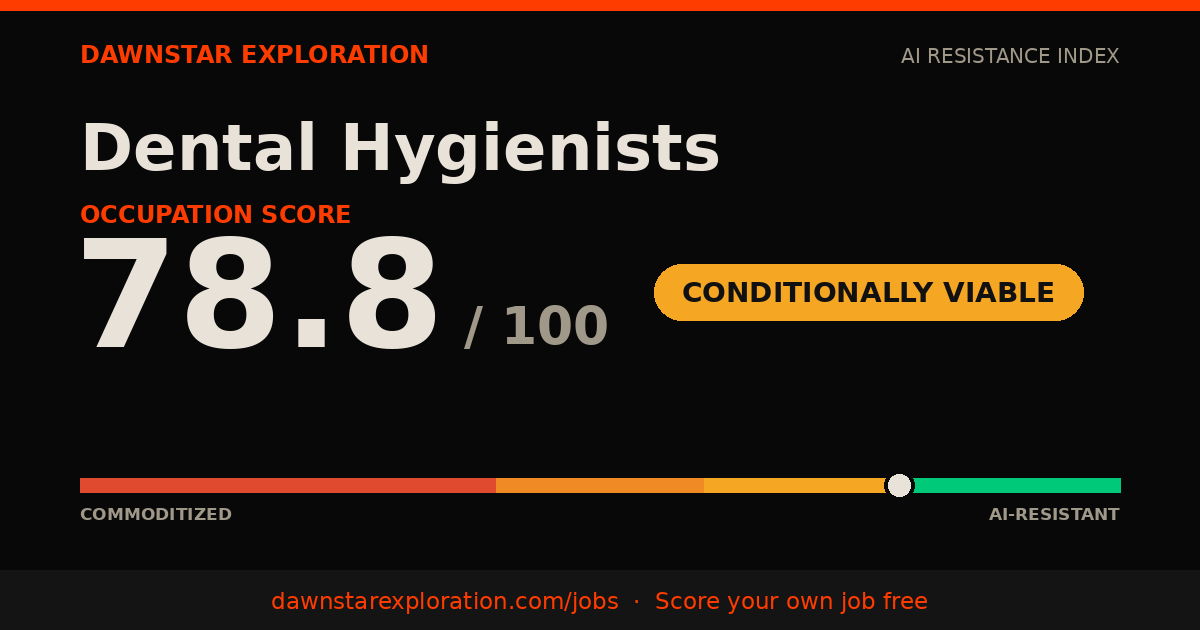
No. Dental hygienists score 78.8/100 on the AI Resistance Index (Conditionally Viable), a few points below dentists. The core of the job is cleaning teeth by hand inside a patient's mouth, under a state licence, for patients who often see the same hygienist for years. AI is arriving in the parts around that work: reading x rays, charting and patient reminders. Those tools change the paperwork, not who holds the instruments.
Higher is safer. Scored on six structural dimensions, weighted as shown below.
How the score breaks down
Each dimension is rated 1 (AI holds every advantage) to 5 (strong structural protection). A rating's contribution is (rating − 1) ÷ 4 × weight, so a 1 contributes nothing and a 5 contributes the full weight.
| Dimension | Weight | Rating | Points |
|---|---|---|---|
| Automation Replaceability | 25% | 4 / 5 | 18.75 |
| Regulatory & Liability Friction | 20% | 4 / 5 | 15 |
| Human Judgment Density | 15% | 4 / 5 | 11.25 |
| Physical-World Coupling | 15% | 5 / 5 | 15 |
| Trust & Relationship Lock-In | 15% | 4 / 5 | 11.25 |
| AI Capital Intensity | 10% | 4 / 5 | 7.5 |
| Total | 100% | 78.8 |
Points are exact; the scoring engine rounds the total to one decimal.
Why each dimension scores the way it does
Rated 4. Removing tartar, stains and plaque, applying sealants and fluoride, and positioning a patient for x rays are manual tasks that software cannot perform. The exposed parts are reading the x rays, documenting care and delivering standard hygiene advice, where AI imaging tools and automated charting already help. Those are a minority of the working day, which is why this rates 4 rather than 5.
Rated 4. BLS reports that every state requires dental hygienists to be licensed, usually after an accredited degree and written and clinical exams, with continuing education to keep the licence. It rates one point below dentists because the tasks a hygienist may perform, and how closely a dentist must supervise them, vary by state, and the dentist carries the final clinical responsibility for diagnosis and treatment.
Rated 4. A hygienist assesses each patient's oral health, decides how to treat sensitive or diseased gums, notices what looks wrong and reports findings to the dentist. Mouths, medical histories and pain tolerance all differ, and the work is done on a conscious patient. Routine cleanings follow protocol, but spotting the patient who needs more than a routine cleaning is judgment.
Rated 5, the maximum. Hygiene work is fine manual work with sharp instruments in a small, wet, moving space, on a person who can feel every slip. No robot does this safely or economically today. Like dentistry itself, it is tied to hands and a chair, and it cannot be delivered through a screen.
Rated 4. Patients spend most of a routine dental visit with the hygienist, often the same one for years, and many are anxious about the chair. Comfort with a particular hygienist keeps patients coming back to a practice. The relationship belongs partly to the practice and the dentist rather than to the hygienist alone, which keeps this from the maximum.
Rated 4. Replacing a hygienist would take a robotic system able to clean below the gum line safely on real patients, plus clinical trials and regulatory approval, which is a frontier-scale problem with no product close to market. Imaging and charting software is cheap and already in use, so the cost barrier protects the hands-on work, not the paperwork around it.
Which dental hygiene tasks AI takes first
BLS lists the core duties of dental hygienists. Sorted by exposure:
Most exposed to AI
- Reading and developing dental x rays
- Documenting patient care and treatment plans
- Standard patient education on brushing and flossing
- Appointment reminders and recall scheduling
Most durable
- Removing tartar, stains and plaque from teeth
- Applying sealants and fluorides
- Assessing a patient's oral health in the chair
- Calming and coaching anxious patients
The labor market today
| Median annual pay (May 2025) | $98,100 |
| Jobs (2025) | 225,300 |
| Projected change, 2025–35 | 8% (much faster than average) |
| Openings per year, on average | ≈15,000 |
| Jobs in dentists' offices | 94% |
BLS projects employment of dental hygienists to grow 8% from 2025 to 2035, much faster than average, with about 15,000 openings a year. It expects demand from a growing older population keeping more of their own teeth, research linking oral health to general health, and state laws that let hygienists do more of what they are trained for. Its outlook does not mention AI.
AI's role in the hygiene room is as an assistant: software that flags decay or bone loss on an x ray, and tools that write the chart notes. That can shorten the paperwork and leave more of the appointment for the cleaning itself.
How to raise your resistance
- Use the imaging tools, don't fear them. Hygienists who can read what the software flags, and explain it to a patient in the chair, become more useful to the dentist and the practice.
- Add permitted procedures. BLS notes that states increasingly let hygienists work at the top of their training. Local anaesthesia permits and expanded-function credentials move you further into hands-on work.
- Build your own patient following. Patients who ask for you by name are the strongest job security in a dental office, and they follow a good hygienist between practices.
- Keep the licence portable. Requirements vary by state. Keeping continuing education current and knowing the rules where you might move protects your options.
This score rates the occupation as a whole. Your exposure depends on what you actually do all day. The free Job Safety score asks about your specific role and day-to-day work, then rates your role on the same six dimensions in about a minute.
Score my job — freeQuestions people ask
Will AI replace dental hygienists?
No. Cleaning teeth is licensed, hands-on work inside a patient's mouth, and no robot does it today. AI is taking over parts of x ray reading and record-keeping, and BLS still projects 8% employment growth from 2025 to 2035.
How does a dental hygienist's score compare with a dentist's?
A few points lower. The hands-on work is just as hard to automate, but dentists carry the final clinical and legal responsibility, so they rate higher on licensing and liability.
Is dental hygiene a good career for the AI era?
By this index it is one of the more durable jobs. The median pay was $98,100 in May 2025, the usual entry route is an associate's degree, and every state requires a licence.
Use this score on your site
Writing about this job and AI? You're welcome to show this score card. Copy the code below: it displays the card and credits the source.
Compare with
Sources and method
Ratings are Dawnstar Exploration's structural assessment using the six-dimension AI Resistance Index framework; labor-market figures are quoted from the sources above as published. This page describes an occupation, not any individual.