Will AI replace surface pattern designers?
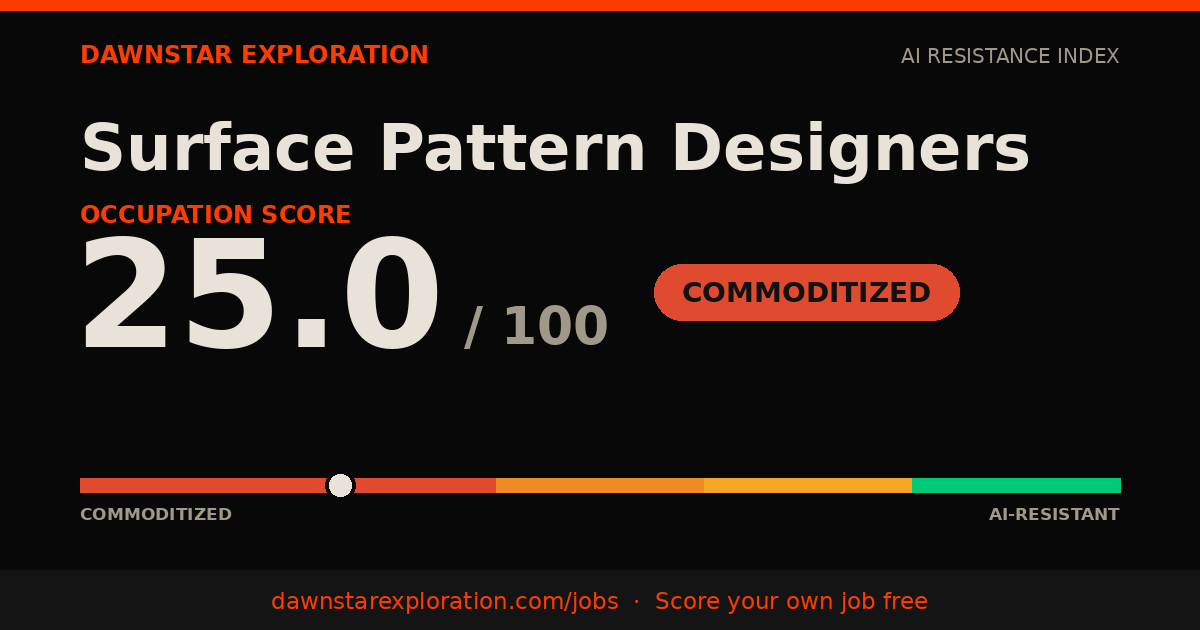
Much of the basic output, yes. Surface pattern design scores 25.0/100 on the AI Resistance Index (Commoditized): image models generate repeating patterns in seconds, and print-on-demand marketplaces are filling with them. What holds up is a recognizable style, collections built for a brand and season, production-ready files, and designs that brands can actually own and license.
Higher is safer. Scored on six structural dimensions, weighted as shown below.
How the score breaks down
Each dimension is rated 1 (AI holds every advantage) to 5 (strong structural protection). A rating's contribution is (rating − 1) ÷ 4 × weight, so a 1 contributes nothing and a 5 contributes the full weight.
| Dimension | Weight | Rating | Points |
|---|---|---|---|
| Automation Replaceability | 25% | 2 / 5 | 6.25 |
| Regulatory & Liability Friction | 20% | 1 / 5 | 0 |
| Human Judgment Density | 15% | 3 / 5 | 7.5 |
| Physical-World Coupling | 15% | 2 / 5 | 3.75 |
| Trust & Relationship Lock-In | 15% | 3 / 5 | 7.5 |
| AI Capital Intensity | 10% | 1 / 5 | 0 |
| Total | 100% | 25.0 |
Points are exact; the scoring engine rounds the total to one decimal.
Why each dimension scores the way it does
Rated 2. Generating motifs and seamless repeating patterns is a strength of image models, and print-on-demand marketplaces are already full of AI-made designs. It rates 2 rather than 1 because a pattern that sells also needs production work: clean repeats at the right scale, limited colorways and files that print correctly on fabric, wallpaper or paper.
Rated 1, the weakest dimension alongside capital. No license is needed to design patterns. Copyright is the closest thing to protection: the U.S. Copyright Office has said material generated entirely by AI is not protected, which matters to brands that license designs and want to own them. That helps human designers in licensing deals but does not stop companies from using AI patterns.
Rated 3, the strongest dimension alongside trust. Building a collection that fits a brand, a season and a price point means choosing motifs, palettes and scales that will sell, and knowing what a retailer's buyers will accept. That taste and market sense come from experience. AI can generate endless options, but someone still has to choose which ones a product line should carry.
Rated 2. Most design work happens in digital tools, but patterns end up on fabric, wallpaper, ceramics and paper, and designers check strike-offs, print samples and color matching against real materials. Hand-painted and hand-drawn work also sells as a mark of craft. Those physical steps keep this rating just above the floor.
Rated 3. Manufacturers and licensing agents return to designers whose signature style sells and who deliver print-ready files on schedule. BLS reports that 20% of graphic designers are self-employed, and for freelance pattern designers those repeat relationships are the business. Buyers looking only for cheap patterns, though, have AI and stock marketplaces as easy alternatives.
Rated 1. Image generators that produce seamless patterns cost a low monthly subscription, and design software now includes AI pattern features. Anyone can upload AI patterns to print-on-demand sites at no cost, which has flooded those marketplaces. With nothing expensive standing in the way, cost gives designers no protection.
Which pattern design tasks AI takes first
BLS covers surface pattern designers most closely under Graphic Designers. The core tasks of the role, sorted by how exposed each is to AI today:
Most exposed to AI
- Generating motifs and seamless repeats
- Creating colorway variations of a design
- Producing patterns for print-on-demand marketplaces
- Mocking up patterns on products
Most durable
- Building collections for a brand, season and price point
- Developing a signature style that licensees ask for
- Preparing print-ready files and checking strike-offs
- Negotiating licenses and protecting original work
The labor market today
| Median annual pay, graphic designers (May 2025) | $62,960 |
| Jobs, graphic designers (2025) | 253,100 |
| Share who are self-employed | 20% |
| Projected change, 2025–35 | −2% |
| Openings per year, on average | ≈16,000 |
| Share employed in manufacturing | 15% |
BLS has no category for surface pattern designers; the closest is Graphic Designers, projected to decline 2% from 2025 to 2035. BLS says automated design tools, such as AI, are projected to make graphic designers more productive, reducing the need for these workers. Manufacturing employs 15% of graphic designers, the largest share after the self-employed.
Pattern design sits at the most exposed end of design, because a repeating pattern is a self-contained image task with clear rules. The score of 25.0 reflects that, set against the brand, licensing and production knowledge that buyers still pay a designer for.
How to raise your resistance
- Develop a signature style. A recognizable look that sells is what licensing agents and brands come back for, and it cannot be prompted generically.
- Sell ownership. Original human-made work can be protected by copyright, which matters to companies that license and invest in designs.
- Master production. Repeats, color separations, scale and strike-off checks are the technical skills that turn an image into a product.
- Use AI for exploration. Generating rough directions quickly leaves more time for refining, curating and building collections.
This score rates the occupation as a whole. Your exposure depends on what you actually do all day. The free Job Safety score asks about your specific role and day-to-day work, then rates your role on the same six dimensions in about a minute.
Score my job — freeQuestions people ask
Will AI replace surface pattern designers?
For basic patterns and print-on-demand designs, increasingly. Designers with a signature style, licensing relationships and production skills hold up better. Surface pattern designers score 25.0/100 on the AI Resistance Index (Commoditized).
Can AI-generated patterns be copyrighted?
The U.S. Copyright Office has said material generated entirely by AI is not protected by copyright, though a person's creative contributions can be. That gives original human work an advantage in licensing deals.
What does BLS say about the outlook?
BLS projects graphic designers, the closest occupation it tracks, to decline 2% from 2025 to 2035, with a median pay of $62,960 in May 2025.
Use this score on your site
Writing about this job and AI? You're welcome to show this score card. Copy the code below: it displays the card and credits the source.
Compare with
Sources and method
Ratings are Dawnstar Exploration's structural assessment using the six-dimension AI Resistance Index framework; labor-market figures are quoted from the sources above as published. This page describes an occupation, not any individual.