Will AI replace retention marketers?
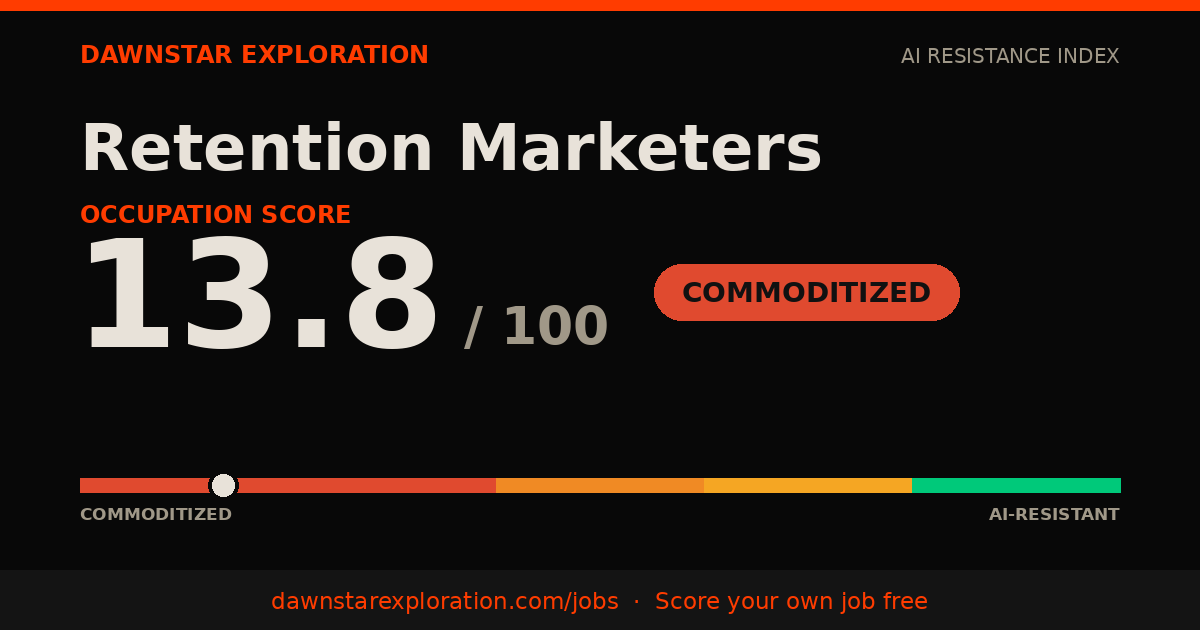
Much of the daily work, yes. Retention marketers score 13.8/100 on the AI Resistance Index (Commoditized), one of the lowest scores in the index. Writing lifecycle emails, segmenting customers, setting up campaigns and testing subject lines are tasks AI tools already do quickly and cheaply, with no licence, no physical presence and no large capital cost standing in the way. What remains is deciding what a business should offer its customers and how much it can afford to spend keeping them.
Higher is safer. Scored on six structural dimensions, weighted as shown below.
How the score breaks down
Each dimension is rated 1 (AI holds every advantage) to 5 (strong structural protection). A rating's contribution is (rating − 1) ÷ 4 × weight, so a 1 contributes nothing and a 5 contributes the full weight.
| Dimension | Weight | Rating | Points |
|---|---|---|---|
| Automation Replaceability | 25% | 2 / 5 | 6.25 |
| Regulatory & Liability Friction | 20% | 1 / 5 | 0 |
| Human Judgment Density | 15% | 2 / 5 | 3.75 |
| Physical-World Coupling | 15% | 1 / 5 | 0 |
| Trust & Relationship Lock-In | 15% | 2 / 5 | 3.75 |
| AI Capital Intensity | 10% | 1 / 5 | 0 |
| Total | 100% | 13.8 |
Points are exact; the scoring engine rounds the total to one decimal.
Why each dimension scores the way it does
Rated 2. BLS has no category for retention marketing. The closest, market research analysts and marketing specialists, include measuring the effectiveness of marketing programs, analyzing data and presenting findings. Retention work is built from those tasks: writing emails and messages, segmenting a customer list, scheduling campaigns, testing variants and reporting results. AI tools already do each of these, so most of the daily work is exposed.
Rated 1, the minimum. No licence or credential is needed to work in marketing, and no regulator requires a human to send a campaign. The rules that do apply, such as consent for marketing email and rules on handling customer data, bind the company and are met by software settings and policy as easily as by a person. Nothing legally requires this to be a human job.
Rated 2. A retention marketer chooses which customers to target, what to offer and when, and reads what the numbers mean. Much of that follows established playbooks, and tools now recommend segments and offers on their own. The remaining judgment is about brand, margin and what a business is prepared to give away to keep a customer, which sits with managers more than with the marketer.
Rated 1, the minimum. The work is done entirely on a screen, through email platforms, customer data tools and analytics. It does not depend on being in any place, and nothing about it requires a person in a room. It can be done from anywhere and by software without any change to how it is performed.
Rated 2. The relationships that matter in retention marketing are between the business and its customers, and those belong to the company, not to the marketer. Employers value a marketer who has moved a number, but marketers are hired and replaced on results and cost. Freelancers with a strong record keep some lock-in, but it is limited.
Rated 1, the minimum. Email assistants, segmentation tools and analytics are inexpensive and many are bundled into the platforms businesses already pay for. There is no meaningful cost barrier to automating this work, and the tools improve and fall in price every year. That makes it among the cheapest kinds of work to automate.
Which parts of retention marketing AI takes first
BLS lists what market research analysts and marketing specialists, the closest category to retention marketing, typically do. Sorted by exposure:
Most exposed to AI
- Writing lifecycle emails, subject lines and messages
- Segmenting customers and building audiences
- Setting up, scheduling and testing campaigns
- Reporting on churn, open rates and campaign results
Most durable
- Deciding what a business can afford to offer to keep a customer
- Setting retention strategy with the people who own the numbers
- Knowing the product and customers well enough to know why they leave
- Owning the brand voice and what the company will not say
The labor market today
| Median annual pay, market research analysts (May 2025) | $78,760 |
| Jobs, market research analysts (2025) | 952,700 |
| Projected change, 2025–35 | 7% (much faster than average) |
| Openings per year, on average | ≈82,000 |
BLS does not publish figures for retention marketers. Its closest category, market research analysts, which also covers marketing specialists, is projected to grow 7% from 2025 to 2035, much faster than average, with about 82,000 openings a year. Its outlook does not mention AI.
That BLS category is broader than retention marketing and leans toward research and analysis, so the pay and job figures here are only a rough guide to the field. Fast projected growth for the category does not conflict with a low score: this index measures how exposed the tasks are to AI, not how many jobs are expected to be advertised.
How to raise your resistance
- Move from sending to deciding. Writing and scheduling campaigns are the parts AI does best. Retention marketers who own the strategy, the offer and the economics of keeping a customer are doing the work that is left.
- Learn the numbers behind churn. Knowing why customers leave, what keeping one is worth and how to prove a campaign worked makes a marketer useful to the people who set budgets, in a way a copy-and-send role is not.
- Get close to the product and the customer. Marketers who talk to customers and understand the product spot what a tool trained on past campaigns will miss. That knowledge is hard to automate.
- Use the tools better than the people around you. The marketers least exposed are the ones who direct AI well: setting it up, checking its output and fixing what it gets wrong. Being faster with the tools is a way to stay ahead of those who are not.
This score rates the occupation as a whole. Your exposure depends on what you actually do all day. The free Job Safety score asks about your specific role and day-to-day work, then rates your role on the same six dimensions in about a minute.
Score my job — freeQuestions people ask
Will AI replace retention marketers?
Much of the daily work, yes. Writing lifecycle emails, segmenting customers and scheduling campaigns are tasks AI tools already do well, and no licence or physical presence protects the role. The strategy and economics of keeping customers remain human decisions for now.
Why do retention marketers score so low on this index?
The work is done entirely on a screen, needs no licence, is inexpensive to automate and has weak relationship lock-in. Those are the factors that protect other jobs, and this one has little of any of them.
What does BLS say about retention marketing?
BLS has no category for it. The closest, market research analysts and marketing specialists, is projected to grow 7% from 2025 to 2035. BLS does not say how AI will affect that growth, and this page's score measures task exposure, not job counts.
Use this score on your site
Writing about this job and AI? You're welcome to show this score card. Copy the code below: it displays the card and credits the source.
Compare with
Sources and method
Ratings are Dawnstar Exploration's structural assessment using the six-dimension AI Resistance Index framework; labor-market figures are quoted from the sources above as published. This page describes an occupation, not any individual.