Will AI replace doctors?
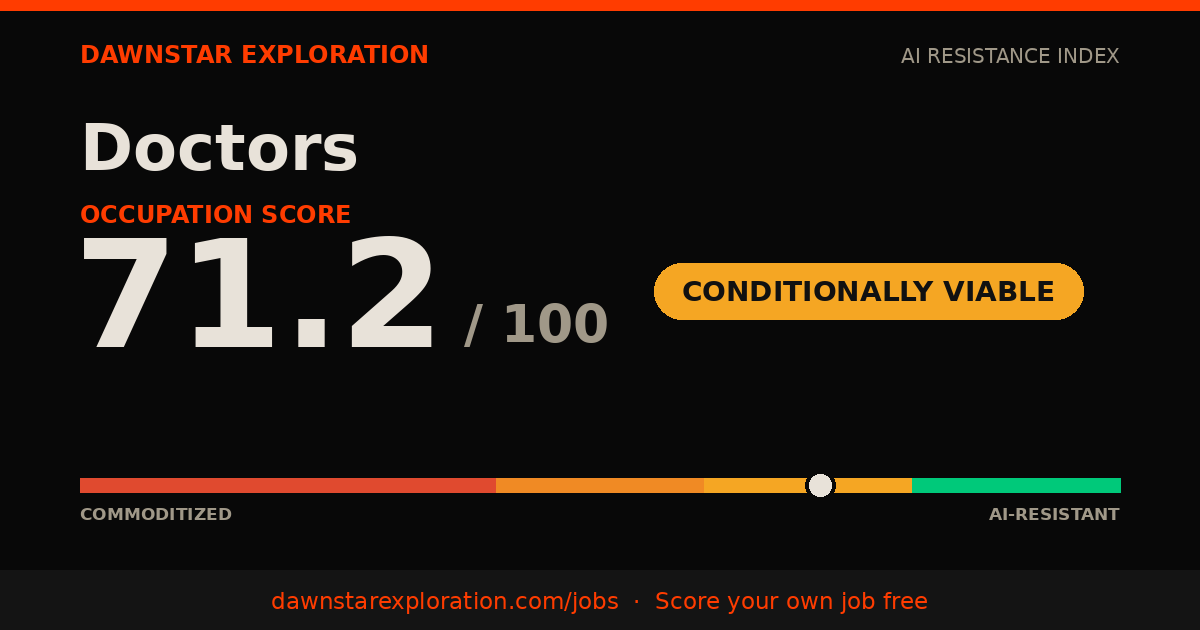
No, but it will change the job. Doctors score 71.2/100 on the AI Resistance Index (Conditionally Viable). A large part of a physician's day is information work: taking a history, reading test results, working out a diagnosis and writing it all down, and AI is already capable at each of these. What holds the profession up is everything around that work. A doctor is licensed after years of training, examines and treats patients in person, makes the final call when the stakes are a life, and is personally liable for it.
Higher is safer. Scored on six structural dimensions, weighted as shown below.
How the score breaks down
Each dimension is rated 1 (AI holds every advantage) to 5 (strong structural protection). A rating's contribution is (rating − 1) ÷ 4 × weight, so a 1 contributes nothing and a 5 contributes the full weight.
| Dimension | Weight | Rating | Points |
|---|---|---|---|
| Automation Replaceability | 25% | 2 / 5 | 6.25 |
| Regulatory & Liability Friction | 20% | 5 / 5 | 20 |
| Human Judgment Density | 15% | 5 / 5 | 15 |
| Physical-World Coupling | 15% | 4 / 5 | 11.25 |
| Trust & Relationship Lock-In | 15% | 4 / 5 | 11.25 |
| AI Capital Intensity | 10% | 4 / 5 | 7.5 |
| Total | 100% | 71.2 |
Points are exact; the scoring engine rounds the total to one decimal.
Why each dimension scores the way it does
Rated 2. BLS lists a physician's typical duties as taking a medical history, documenting findings in the chart, ordering tests, reviewing results for abnormal findings and designing a treatment plan. Most of those are information tasks, and AI already drafts chart notes, flags abnormal results and suggests diagnoses. The physical exam, procedures and surgery are the parts it cannot do, which keeps this above the minimum.
Rated 5, the maximum. BLS reports that every state requires physicians to be licensed, after graduating from an accredited medical school, completing a residency of 3 to 9 years and passing national exams. Only a licensed physician may diagnose, prescribe and operate, and that physician carries malpractice liability for the outcome. Software cannot hold a licence or be sued for a missed diagnosis.
Rated 5, the maximum. Patients arrive with incomplete histories, several conditions at once and symptoms that do not match the textbook. Deciding what matters, what to test, when to treat and when to wait is judgment under uncertainty with a life at stake, and the doctor has to weigh what the patient wants as well as what the evidence says.
Rated 4. Examining a patient, performing procedures and operating all require hands on a body in a room. It rates one point below the maximum because a growing share of consultations, follow-ups and prescription reviews happens over video or messaging, and that part of medicine has no physical barrier to automation.
Rated 4. People want a doctor they know to tell them a diagnosis and to be answerable for their care, and many keep the same physician for years. Trust is weaker in urgent care and one-off specialist visits, where the patient has never met the doctor before, which keeps this from the maximum.
Rated 4. Software for notes and decision support is cheap, but replacing a physician's clinical authority would mean clinical trials, regulatory approval for each use and someone to accept the liability. That is slow and expensive for any company to attempt, so cost and approval protect the core of the job while the paperwork around it automates.
Which parts of a doctor's work AI takes first
BLS lists what physicians and surgeons typically do. Sorted by exposure:
Most exposed to AI
- Documenting and updating charts and patient information
- Reviewing test results to identify abnormal findings
- Answering routine patient questions and follow-up messages
- Drafting a first-pass diagnosis and treatment options
Most durable
- Performing a physical exam
- Procedures and surgery
- Deciding the treatment plan and answering for it
- Giving a patient hard news and agreeing what to do next
The labor market today
| Median annual pay (May 2025) | $275,930 |
| Jobs (2025) | 862,800 |
| Projected change, 2025–35 | 4% (about as fast as average) |
| Openings per year, on average | ≈22,100 |
BLS projects employment of physicians and surgeons to grow 4% from 2025 to 2035, about as fast as average, with about 22,100 openings a year. It expects demand from a growing number of older adults and rising rates of chronic illness. Its outlook does not mention AI.
Exposure differs a great deal by specialty. Radiologists, whose work is reading images, score 45.0 on this index, while a surgeon's day is almost entirely hands-on. This page scores the profession as a whole.
How to raise your resistance
- Let AI take the charting. Documentation is the part of the day AI does best. Doctors who hand it over get time back for patients, which is the part that protects the job.
- Stay close to procedures and exams. Work that needs hands on a patient is the most durable part of medicine. Specialties built on reading data alone are the most exposed.
- Own the decision. AI can suggest a diagnosis, and a licensed physician still decides and answers for it. Being able to check and overrule the software is the skill to keep sharp.
- Keep your own patients. A panel of patients who know and trust you is something no system or employer can swap out cheaply.
This score rates the occupation as a whole. Your exposure depends on what you actually do all day. The free Job Safety score asks about your specific role and day-to-day work, then rates your role on the same six dimensions in about a minute.
Score my job — freeQuestions people ask
Will AI replace doctors?
No. AI is taking over charting, test review and first-pass diagnosis, but only a licensed physician may diagnose, prescribe and operate, and the physician is liable for the result. BLS projects 4% employment growth from 2025 to 2035.
Why do doctors score lower than dentists on this index?
More of a typical doctor's day is information work, such as reading results and writing notes, which AI does well. A dentist's income comes almost entirely from hands-on procedures. Both rate at the maximum for licensing and liability.
Which doctors are most exposed to AI?
Those whose work is mostly reading data. Radiologists score 45.0 on this index because interpreting images is the task image models do best. Doctors who examine, operate and manage patients in person are far less exposed.
Use this score on your site
Writing about this job and AI? You're welcome to show this score card. Copy the code below: it displays the card and credits the source.
Compare with
Sources and method
Ratings are Dawnstar Exploration's structural assessment using the six-dimension AI Resistance Index framework; labor-market figures are quoted from the sources above as published. This page describes an occupation, not any individual.