Will AI replace public sector data processors?
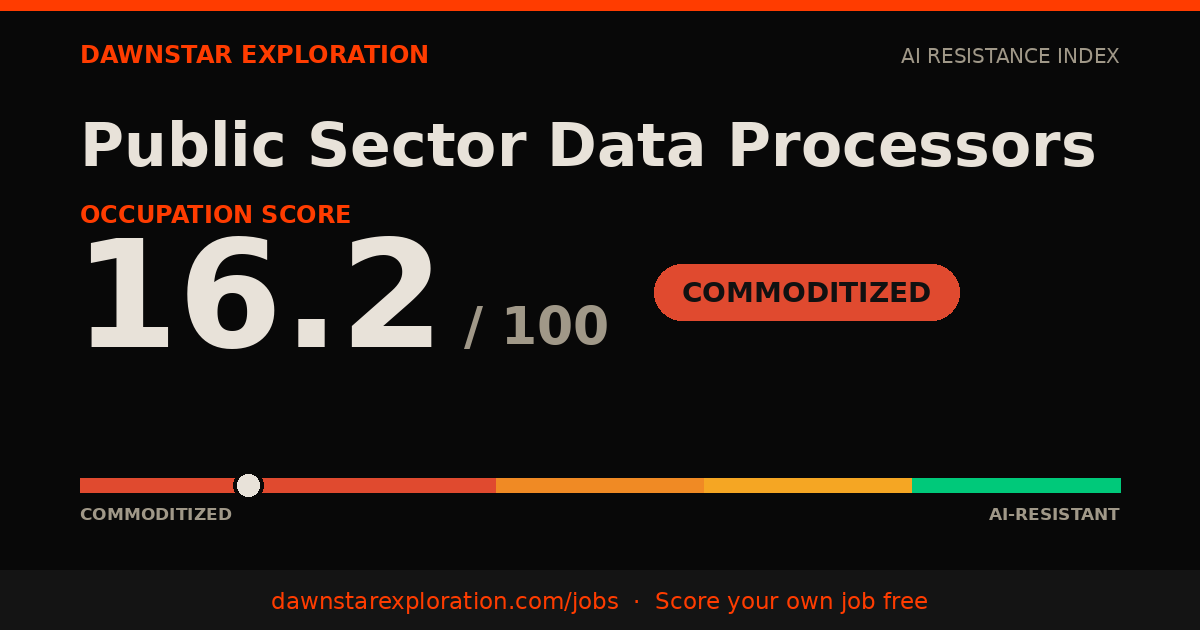
Largely, yes. Government data processing scores 16.2/100 on the AI Resistance Index (Commoditized), among the lowest in the index. Keying forms, checking applications and updating records are the work document AI and process automation do best, and BLS expects electronic data collection to limit demand for many interviewers other than those who determine eligibility. Public-facing work, disputed cases and checking automated results hold up longest.
Higher is safer. Scored on six structural dimensions, weighted as shown below.
How the score breaks down
Each dimension is rated 1 (AI holds every advantage) to 5 (strong structural protection). A rating's contribution is (rating − 1) ÷ 4 × weight, so a 1 contributes nothing and a 5 contributes the full weight.
| Dimension | Weight | Rating | Points |
|---|---|---|---|
| Automation Replaceability | 25% | 1 / 5 | 0 |
| Regulatory & Liability Friction | 20% | 3 / 5 | 10 |
| Human Judgment Density | 15% | 1 / 5 | 0 |
| Physical-World Coupling | 15% | 1 / 5 | 0 |
| Trust & Relationship Lock-In | 15% | 2 / 5 | 3.75 |
| AI Capital Intensity | 10% | 2 / 5 | 2.5 |
| Total | 100% | 16.2 |
Points are exact; the scoring engine rounds the total to one decimal.
Why each dimension scores the way it does
Rated 1, the weakest dimension and the most heavily weighted. Keying data from forms, checking applications for missing fields, matching records and updating case files is structured, repetitive work that document AI and robotic process automation handle well. BLS expects electronic data collection and document submission to limit demand for many interviewers other than those who determine eligibility, and online self-service removes much of the keying altogether.
Rated 3, the strongest dimension. Public records laws, privacy rules and program regulations demand accuracy and audit trails, and errors in benefits or licensing can lead to appeals. Those rules slow the adoption of automation in government and require review of disputed cases. But they mandate accurate, accountable processing, not a person keying each record, so they protect the oversight more than the data entry.
Rated 1. Most of the work follows fixed procedures: enter the data, check it against the rules, route the case. Exceptions and judgment calls are escalated to caseworkers or supervisors rather than decided by the processor, which leaves very little of the role that depends on discretion and makes it straightforward to codify.
Rated 1. Forms increasingly arrive online, and paper ones are scanned before processing, so the work happens on a screen and can be done from any office or remotely. Handling physical mail and files is a shrinking share of the job, and it is the part that scanning centers and automated mailrooms take over first.
Rated 2. Experienced processors know a program's forms, codes and common errors, and some deal directly with the public at counters or by phone, where courtesy and patience matter. That knowledge has value, but the role is defined by the position rather than personal relationships, and people applying for services rarely ask for a particular clerk.
Rated 2. Document AI and process automation are commercially available, but agencies have to buy them through public procurement, connect them to older case management systems and pass security reviews before using them. Those costs and delays slow adoption a little, which keeps this above the floor, though they do not stop it.
Which records tasks AI takes first
BLS has no category for public sector data processors; the closest is Information Clerks, which includes eligibility interviewers for government programs. The core tasks, sorted by how exposed each is to AI today:
Most exposed to AI
- Keying data from paper and online forms
- Checking applications for missing or inconsistent fields
- Matching and updating records across systems
- Answering routine status questions
Most durable
- Helping members of the public with complex applications
- Reviewing cases that automated checks flag
- Correcting errors before they lead to appeals
- Explaining decisions to people in person
The labor market today
| Median annual pay, information clerks (May 2025) | $45,430 |
| Median annual pay, eligibility interviewers, government programs (May 2025) | $54,210 |
| Jobs, information clerks (2025) | 1,287,600 |
| Projected change, information clerks, 2025–35 | −2% |
| Projected change, eligibility interviewers, 2025–35 | +2% |
| Share of information clerks in local government | 18% |
| Typical entry-level education | High school diploma |
BLS has no category for public sector data processors. The closest is Information Clerks, projected to decline 2% from 2025 to 2035, with local government employing 18% of them. Within the group, eligibility interviewers for government programs are projected to grow 2%, but BLS says electronic data collection and document submission will limit demand for many other interviewers.
The pattern is consistent: work that consists of moving information from one form to another is automated quickly, while deciding cases and helping people changes far more slowly. The score of 16.2 reflects a role made almost entirely of the first kind.
How to raise your resistance
- Move toward casework. Eligibility determination and case management add judgment and public contact that data entry lacks.
- Become the exception handler. Automated systems flag the cases they cannot resolve, and the people who review those flags become more important.
- Learn the systems. Knowing how the agency's case management and automation tools work makes you useful in the transition rather than replaced by it.
- Work with the public. Counter and phone service for people who struggle with online forms remains a human job in most agencies.
This score rates the occupation as a whole. Your exposure depends on what you actually do all day. The free Job Safety score asks about your specific role and day-to-day work, then rates your role on the same six dimensions in about a minute.
Score my job — freeQuestions people ask
Will AI replace government data processors?
Largely, yes, for data entry and routine record work. Public-facing and casework roles hold up better. Government data processors score 16.2/100 on the AI Resistance Index (Commoditized).
Doesn't government regulation protect these jobs?
Somewhat, which is why Regulatory & Liability Friction rates 3 of 5. But the rules require accurate and accountable processing, not a person typing each record, so they slow automation rather than prevent it.
What does BLS say about pay?
BLS reports a median of $45,430 for information clerks in May 2025 and $54,210 for eligibility interviewers in government programs. Information clerks typically need a high school diploma and learn on the job.
Use this score on your site
Writing about this job and AI? You're welcome to show this score card. Copy the code below: it displays the card and credits the source.
Compare with
Sources and method
Ratings are Dawnstar Exploration's structural assessment using the six-dimension AI Resistance Index framework; labor-market figures are quoted from the sources above as published. This page describes an occupation, not any individual.