Will AI replace federal and public sector administrators?
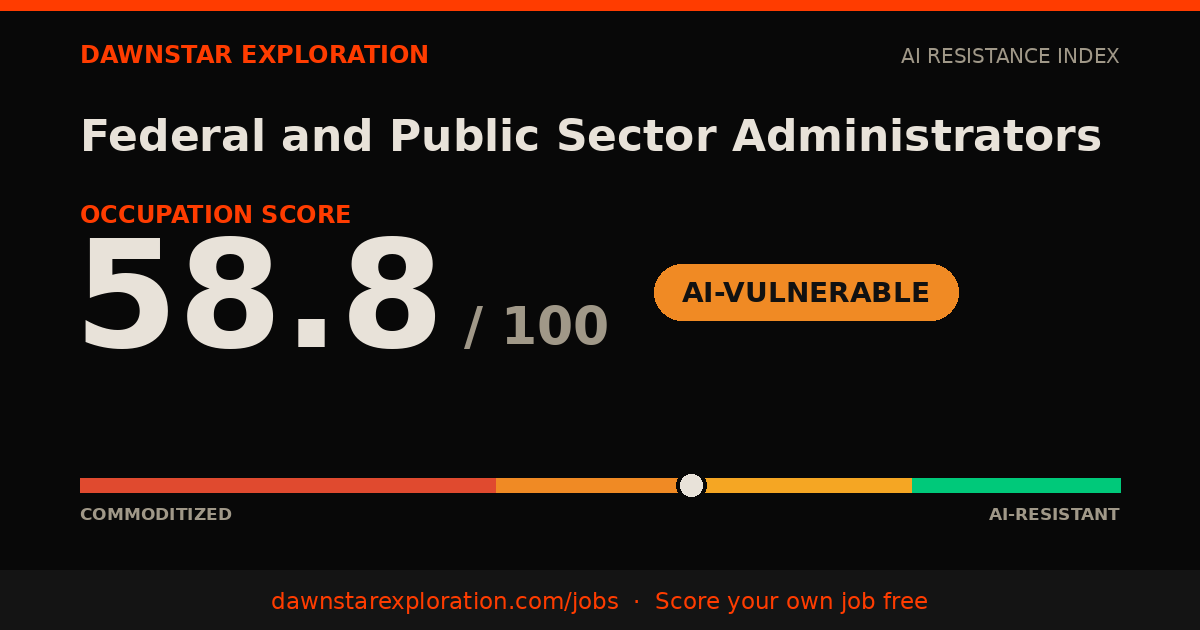
Not soon, but the desk work is exposed. Government administration scores 58.8/100 on the AI Resistance Index (AI-Vulnerable). Drafting, summarizing and routine processing are what AI does well, but public decisions run through statutes, appeal rights and accountable officials, and getting AI approved and connected inside government is slow and costly. That combination buys time rather than permanent protection.
Higher is safer. Scored on six structural dimensions, weighted as shown below.
How the score breaks down
Each dimension is rated 1 (AI holds every advantage) to 5 (strong structural protection). A rating's contribution is (rating − 1) ÷ 4 × weight, so a 1 contributes nothing and a 5 contributes the full weight.
| Dimension | Weight | Rating | Points |
|---|---|---|---|
| Automation Replaceability | 25% | 3 / 5 | 12.5 |
| Regulatory & Liability Friction | 20% | 5 / 5 | 20 |
| Human Judgment Density | 15% | 3 / 5 | 7.5 |
| Physical-World Coupling | 15% | 2 / 5 | 3.75 |
| Trust & Relationship Lock-In | 15% | 3 / 5 | 7.5 |
| AI Capital Intensity | 10% | 4 / 5 | 7.5 |
| Total | 100% | 58.8 |
Points are exact; the scoring engine rounds the total to one decimal.
Why each dimension scores the way it does
Rated 3. A large share of administrative work, drafting memos and reports, summarizing regulations, answering routine inquiries and processing standard requests, is text and data work that AI handles well. It rates 3 rather than lower because government processes are spread across legacy systems, paper records and rules that differ by program, which limits how much can be automated from end to end.
Rated 5, the strongest dimension and the maximum. Government decisions sit inside statutes, appeal rights, records laws and oversight by inspectors general and legislatures, and an accountable official has to sign for them. Federal guidance requires agencies to manage the risks of AI used in decisions that affect people's rights or safety. That chain of accountability keeps a person in the loop even where software does the analysis.
Rated 3. Applying policy to cases that do not fit the rules, balancing competing statutory requirements and deciding what to escalate to leadership all take judgment. Much day-to-day administration, though, follows established procedures and guidance, and those routine steps are exactly what agencies are trying to streamline first.
Rated 2, the weakest dimension. Most public sector administration is documentation, policy, budgets and process, done at a desk and increasingly by telework. Managing facilities, office moves and in-person public services adds some physical work, and BLS groups facilities managers with administrative services managers, but for most administrators the job lives on a screen.
Rated 3. Long-serving administrators know how an agency actually works: which office owns what, which rules have exceptions and whom to call. That knowledge is hard to replace quickly. But civil service roles are defined by the position rather than the person, and reorganizations, hiring freezes and budget cuts can remove a role regardless of who fills it.
Rated 4. Bringing AI into government is expensive and slow. Cloud services used by federal agencies need FedRAMP authorization, new systems need an authority to operate and security reviews, and much data sits in legacy systems that are hard to connect. Procurement cycles add years. Those costs and delays protect administrative roles more than they would in a private company.
Which administrative tasks AI takes first
BLS has no category for government administrators; the closest is Administrative Services and Facilities Managers. The core tasks of the role, sorted by how exposed each is to AI today:
Most exposed to AI
- Drafting memos, reports and correspondence
- Summarizing regulations, guidance and policy changes
- Processing routine requests and records
- Compiling budget and performance data
Most durable
- Signing decisions an official must answer for
- Applying policy to cases that do not fit the rules
- Coordinating across offices, agencies and oversight bodies
- Managing staff, contracts and facilities
The labor market today
| Median annual pay, administrative services managers (May 2025) | $114,130 |
| Median annual pay, administrative services managers in state government (May 2025) | $103,790 |
| Jobs, administrative services and facilities managers (2025) | 444,800 |
| Projected growth, 2025–35 | +5% (faster than average) |
| Openings per year, on average | ≈36,100 |
| Typical entry-level education | Bachelor's degree |
BLS has no category for federal or public sector administrators. The closest is Administrative Services and Facilities Managers, projected to grow 5% from 2025 to 2035, faster than average. BLS ties demand for administrative services managers to a continued emphasis on efficiency and process improvement in public and private settings.
That emphasis on efficiency is also what drives AI adoption in government. The score of 58.8 reflects strong legal protection and slow, costly technology adoption on one side, and highly digital desk work on the other. The protection is about pace: it delays change more than it prevents it.
How to raise your resistance
- Own the decision, not the paperwork. Roles that sign, approve and answer for outcomes are protected by law; roles that only prepare documents are not.
- Lead the AI rollout. Agencies need administrators who understand both the rules and the tools to decide where AI can safely help.
- Work the hard cases. Exceptions, appeals and cases that cross programs need judgment and authority that automated systems lack.
- Build relationships across agencies. Knowing whom to call in other offices and oversight bodies is institutional knowledge that keeps work moving.
This score rates the occupation as a whole. Your exposure depends on what you actually do all day. The free Job Safety score asks about your specific role and day-to-day work, then rates your role on the same six dimensions in about a minute.
Score my job — freeQuestions people ask
Will AI replace government administrators?
Not soon. Drafting and routine processing are exposed, but statutes, appeal rights and accountable officials keep people in charge of decisions, and AI adoption in government is slow. Government administrators score 58.8/100 on the AI Resistance Index (AI-Vulnerable).
Why is the regulatory rating so high?
Because public decisions have to be made, recorded and defended by accountable officials under statutes, records laws and oversight. That is why Regulatory & Liability Friction rates 5 of 5, the maximum.
What does BLS say about pay and outlook?
BLS reports a median of $114,130 for administrative services managers in May 2025, and $103,790 for those in state government. It projects 5% growth for administrative services and facilities managers from 2025 to 2035.
Use this score on your site
Writing about this job and AI? You're welcome to show this score card. Copy the code below: it displays the card and credits the source.
Compare with
Sources and method
Ratings are Dawnstar Exploration's structural assessment using the six-dimension AI Resistance Index framework; labor-market figures are quoted from the sources above as published. This page describes an occupation, not any individual.