Will AI replace public relations specialists?
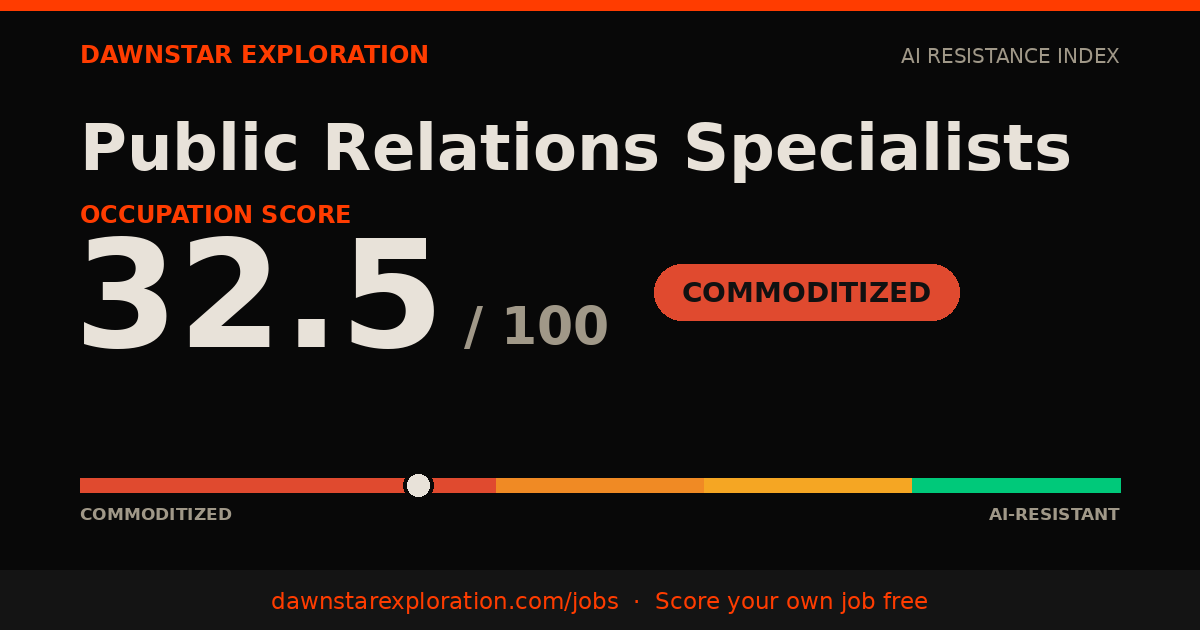
The routine output, increasingly. Public relations scores 32.5/100 on the AI Resistance Index (Commoditized). Press releases, pitches, monitoring and coverage reports are formats AI handles well, and BLS notes that AI may soften demand for these workers. Crisis judgment and trusted relationships with journalists and executives are what hold up.
Higher is safer. Scored on six structural dimensions, weighted as shown below.
How the score breaks down
Each dimension is rated 1 (AI holds every advantage) to 5 (strong structural protection). A rating's contribution is (rating − 1) ÷ 4 × weight, so a 1 contributes nothing and a 5 contributes the full weight.
| Dimension | Weight | Rating | Points |
|---|---|---|---|
| Automation Replaceability | 25% | 2 / 5 | 6.25 |
| Regulatory & Liability Friction | 20% | 2 / 5 | 5 |
| Human Judgment Density | 15% | 3 / 5 | 7.5 |
| Physical-World Coupling | 15% | 2 / 5 | 3.75 |
| Trust & Relationship Lock-In | 15% | 3 / 5 | 7.5 |
| AI Capital Intensity | 10% | 2 / 5 | 2.5 |
| Total | 100% | 32.5 |
Points are exact; the scoring engine rounds the total to one decimal.
Why each dimension scores the way it does
Rated 2, the weakest dimension because it carries the most weight. Press releases, media pitches, fact sheets, social posts and coverage reports are standard formats that AI drafts quickly, and media monitoring and sentiment tracking are already automated. BLS notes that AI is making inroads into social media and may soften demand. It rates 2 because the message still has to suit the moment and the audience.
Rated 2. PR work needs no license, but it carries some legal exposure: disclosure rules for public companies, advertising and endorsement rules, and defamation risk in what a spokesperson says. Those risks mostly sit with the organization and its lawyers, who review sensitive statements, so they slow the automation of high-stakes messages without protecting routine ones.
Rated 3, the strongest dimension alongside trust. Deciding what to say in a crisis, when to stay silent, and how one statement will land with employees, customers and reporters at once takes judgment that is hard to delegate. BLS notes that good and bad news spread rapidly through the internet, which raises the cost of getting those calls wrong.
Rated 2. Most PR work is writing, calls and online monitoring, done from a desk or remotely. Events, press conferences, media training and being on site during a crisis add an in-person element, which keeps this above the floor, but they take up a small part of most PR specialists' working weeks.
Rated 3. Journalists answer pitches from people they know and trust to be accurate, and executives lean on advisers who have handled their crises before. Those relationships are real assets. But clients switch agencies regularly, and mass-produced pitches make it harder for any single sender, human or software, to stand out in a reporter's inbox.
Rated 2. Media databases, monitoring platforms and AI writing tools are sold as subscriptions, and many now include AI drafting and pitching features, so an agency or in-house team can automate routine output cheaply. Relationships, reputation and crisis experience cannot be bought with software, which keeps this rating off the floor.
Which PR tasks AI takes first
BLS describes the core duties of public relations specialists. Sorted by how exposed each is to AI today:
Most exposed to AI
- Writing press releases and fact sheets
- Drafting media pitches and social posts
- Monitoring coverage and public sentiment
- Compiling coverage reports for clients or leadership
Most durable
- Advising leaders on what to say in a crisis
- Building trusted relationships with reporters
- Preparing spokespeople for interviews
- Coordinating statements across legal, HR and leadership
The labor market today
| Median annual pay (May 2025) | $74,750 |
| Jobs (2025) | 314,500 |
| Projected growth, 2025–35 | +2% |
| Openings per year, on average | ≈23,000 |
| Share employed in government | 11% |
| Typical entry-level education | Bachelor's degree |
BLS projects employment of public relations specialists to grow 2% from 2025 to 2035, slower than average, with about 23,000 openings a year. It expects social media to create new opportunities, while noting that AI is making inroads into social media and may soften demand for these workers.
Government is one of the largest employers, with about 11% of PR specialists, according to BLS. The score of 32.5 reflects how much of PR's daily output is standard text, set against the judgment and relationships the job ultimately depends on.
How to raise your resistance
- Be the crisis adviser. Leaders pay for judgment when reputations are at stake, and that is the part of PR least suited to automation.
- Invest in reporter relationships. Journalists answer people they trust to be accurate and useful, which no volume of automated pitches can replace.
- Bring data and stories. Original research, real customer stories and access to experts give reporters something worth covering.
- Run the AI tools. Using AI for monitoring, drafts and reports frees time for strategy and relationships.
This score rates the occupation as a whole. Your exposure depends on what you actually do all day. The free Job Safety score asks about your specific role and day-to-day work, then rates your role on the same six dimensions in about a minute.
Score my job — freeQuestions people ask
Will AI replace PR specialists?
The routine writing and monitoring, increasingly. Crisis judgment and media relationships hold up. Public relations specialists score 32.5/100 on the AI Resistance Index (Commoditized).
What does BLS say about the outlook for PR?
BLS projects 2% growth from 2025 to 2035, with a median pay of $74,750 in May 2025. It notes that social media is creating opportunities while AI may soften demand.
Which PR tasks are most exposed to AI?
Press releases, pitches, monitoring and coverage reports. They follow standard formats, which is why automation replaceability rates 2 of 5.
Use this score on your site
Writing about this job and AI? You're welcome to show this score card. Copy the code below: it displays the card and credits the source.
Compare with
Sources and method
Ratings are Dawnstar Exploration's structural assessment using the six-dimension AI Resistance Index framework; labor-market figures are quoted from the sources above as published. This page describes an occupation, not any individual.