Will AI replace operations managers?
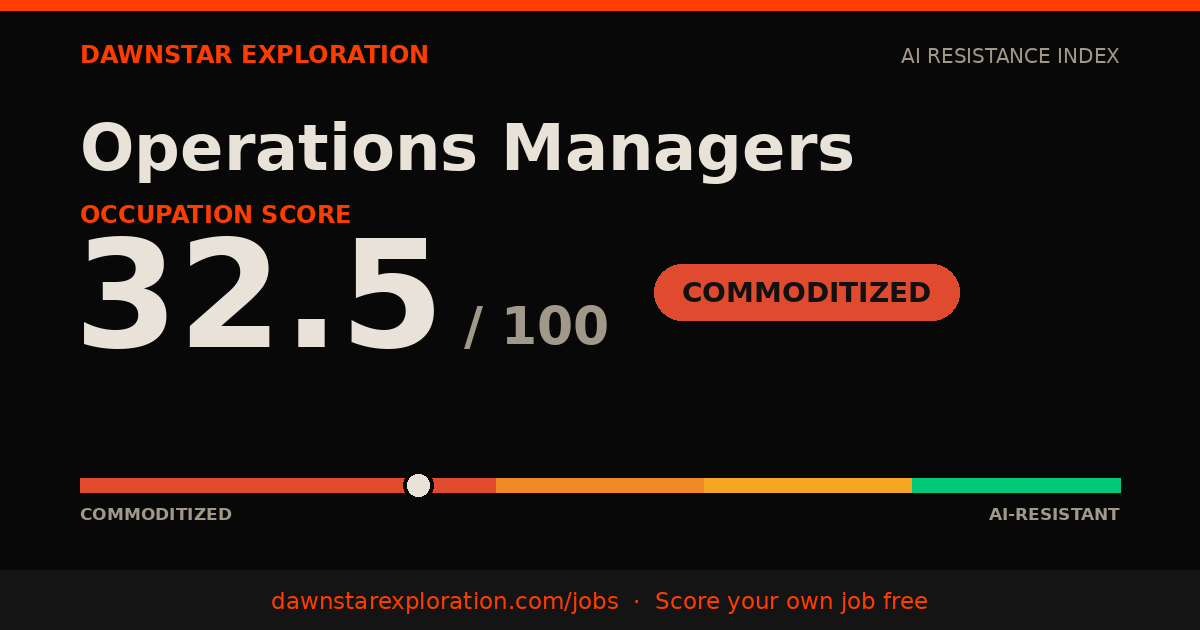
Parts of the job, yes; the job itself, not yet. Operations managers score 32.5/100 on the AI Resistance Index (Commoditized), a low score. The reporting side of operations is exposed: scheduling, tracking performance, budgeting and writing status updates are tasks software does quickly and cheaply. What holds the role up is people. An operations manager appoints and manages staff, negotiates with suppliers, handles the exceptions that nothing predicted and is answerable to the owner when something goes wrong.
Higher is safer. Scored on six structural dimensions, weighted as shown below.
How the score breaks down
Each dimension is rated 1 (AI holds every advantage) to 5 (strong structural protection). A rating's contribution is (rating − 1) ÷ 4 × weight, so a 1 contributes nothing and a 5 contributes the full weight.
| Dimension | Weight | Rating | Points |
|---|---|---|---|
| Automation Replaceability | 25% | 2 / 5 | 6.25 |
| Regulatory & Liability Friction | 20% | 2 / 5 | 5 |
| Human Judgment Density | 15% | 3 / 5 | 7.5 |
| Physical-World Coupling | 15% | 2 / 5 | 3.75 |
| Trust & Relationship Lock-In | 15% | 3 / 5 | 7.5 |
| AI Capital Intensity | 10% | 2 / 5 | 2.5 |
| Total | 100% | 32.5 |
Points are exact; the scoring engine rounds the total to one decimal.
Why each dimension scores the way it does
Rated 2. BLS describes top executives, the group that includes general and operations managers, as people who set and carry out goals and procedures, oversee budgets and financial activity, manage the general activities of making products and providing services and consult with other managers and staff. Much of that coordination is information work: scheduling, tracking, reporting and budgeting. Software already does it quickly, so a large share of the role is exposed.
Rated 2. BLS lists a bachelor's degree and five years or more of related experience as the typical route into this group, but no licence. A company needs no permit to put software in charge of its scheduling. What exists is the manager's accountability for safety, labor rules and contracts, but that sits with the employer as much as the individual and does not require a human to do the scheduling, so it offers little protection.
Rated 3. An operations manager makes many calls in a day: who covers a shift, which order to prioritize, whether a supplier problem warrants an expensive fix, when to escalate. Some follow rules, and software can recommend answers. But the cases that reach a manager are the ones that fall outside the rules, and those are judgment calls, so the rating sits in the middle.
Rated 2. Operations managers often work on the floor of a warehouse, shop or plant, but the management work itself is mostly done through meetings, systems and messages and could be done almost anywhere. The physical environment matters for the people they supervise more than for the manager's own tasks, so the work is only loosely tied to a place.
Rated 3. A manager builds trust with staff, suppliers and the owner over years, and people follow a manager they believe in. A new manager takes time to earn that. But that trust belongs to the company in the short run, since a replacement manager is a normal event, so it offers moderate rather than strong protection.
Rated 2. Dashboards, scheduling tools and reporting assistants are inexpensive, and many already come bundled with the software businesses use. There is no large capital barrier in the way of automating the information side of operations, so cost does little to protect the role. That is a main reason the score is low.
Which parts of operations work AI takes first
BLS lists what top executives, including general and operations managers, typically do. Sorted by exposure:
Most exposed to AI
- Scheduling staff and work
- Tracking performance against goals and writing status reports
- Budgeting and analysing financial statements
- Drafting procedures and policy documents
Most durable
- Appointing, managing and coaching department heads and staff
- Negotiating and approving contracts with suppliers
- Handling the exceptions nothing predicted
- Being accountable to the owner or board for the result
The labor market today
| Median annual pay, top executives (May 2025) | $108,780 |
| Jobs, top executives (2025) | 3,890,600 |
| Of which general and operations managers | about 3.6 million |
| Projected change, 2025–35 | 5% (faster than average) |
| Openings per year, on average | ≈304,100 |
BLS projects employment of top executives to grow 5% from 2025 to 2035, faster than average, with about 304,100 openings a year. Many openings come from people moving to other occupations or leaving the labor force. Its outlook does not mention AI. General and operations managers held about 3.6 million of the 3,890,600 jobs in 2025.
The pay figure covers all top executives, including chief executives, so it is higher than what a typical operations manager at a small business earns. Operations managers work in nearly every industry, and the roles range from running a single shop floor to leading a large department. This page scores the role as a whole.
How to raise your resistance
- Let software run the reporting. Scheduling, dashboards and status reports are the parts of operations that software does best. Managers who hand them over get time for the people and problems that need a person.
- Get closer to the people and the exceptions. Appointing, coaching and handling what the system did not expect is the part of the role that AI cannot take over, so the more of the week it fills the safer the job is.
- Own the supplier and customer relationships. Negotiating terms and keeping the people on the other end of a contract on side is trust work. A manager who holds those relationships is harder to replace.
- Own the result, not the process. Managers who are accountable for a number such as cost, delivery or quality, and can show how they moved it, are valued for the outcome. Managers who mainly relay information are the ones exposed.
This score rates the occupation as a whole. Your exposure depends on what you actually do all day. The free Job Safety score asks about your specific role and day-to-day work, then rates your role on the same six dimensions in about a minute.
Score my job — freeQuestions people ask
Will AI replace operations managers?
Parts of the job, yes. Scheduling, tracking, budgeting and reporting are tasks software already does well. But managers appoint and lead people, negotiate, handle exceptions and answer for results. BLS projects 5% growth for top executives from 2025 to 2035.
Why do operations managers score so much lower than doctors or nurses?
There is no licence to protect the role, the work is mostly information work, and the software that does it is cheap. Medical roles rate at or near the maximum for licensing and for hands-on physical work.
How can an operations manager protect their job?
Move toward the work software cannot do: leading and developing people, handling the exceptions, holding supplier and customer relationships and being accountable for a measurable result.
Use this score on your site
Writing about this job and AI? You're welcome to show this score card. Copy the code below: it displays the card and credits the source.
Compare with
Sources and method
Ratings are Dawnstar Exploration's structural assessment using the six-dimension AI Resistance Index framework; labor-market figures are quoted from the sources above as published. This page describes an occupation, not any individual.