Will AI replace IT operations engineers?
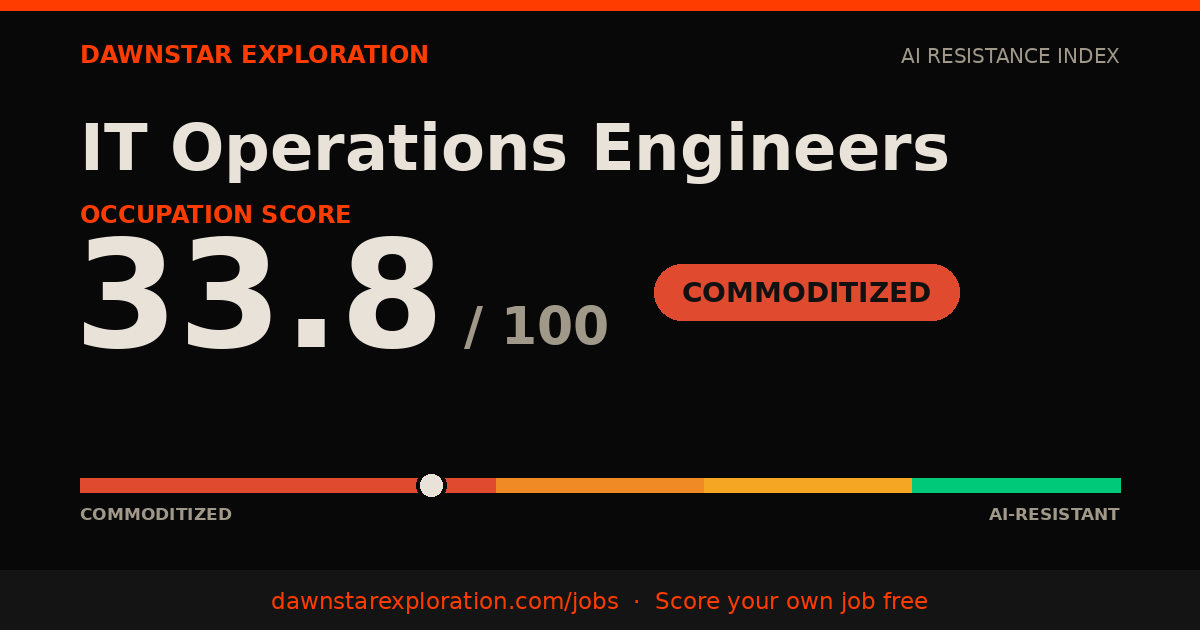
Much of the routine work, yes. IT operations scores 33.8/100 on the AI Resistance Index (Commoditized). Monitoring, alert triage, patching and standard fixes are moving to automation and AIOps tools, and BLS projects network and computer systems administrators to decline 4% from 2025 to 2035. Diagnosing unusual incidents, hands-on infrastructure and deep knowledge of a particular environment are what hold up.
Higher is safer. Scored on six structural dimensions, weighted as shown below.
How the score breaks down
Each dimension is rated 1 (AI holds every advantage) to 5 (strong structural protection). A rating's contribution is (rating − 1) ÷ 4 × weight, so a 1 contributes nothing and a 5 contributes the full weight.
| Dimension | Weight | Rating | Points |
|---|---|---|---|
| Automation Replaceability | 25% | 2 / 5 | 6.25 |
| Regulatory & Liability Friction | 20% | 2 / 5 | 5 |
| Human Judgment Density | 15% | 3 / 5 | 7.5 |
| Physical-World Coupling | 15% | 3 / 5 | 7.5 |
| Trust & Relationship Lock-In | 15% | 3 / 5 | 7.5 |
| AI Capital Intensity | 10% | 1 / 5 | 0 |
| Total | 100% | 33.8 |
Points are exact; the scoring engine rounds the total to one decimal.
Why each dimension scores the way it does
Rated 2. Watching dashboards, sorting alerts, patching, provisioning accounts and running standard fixes from a runbook are increasingly handled by automation and AIOps tools that spot anomalies and act on them. BLS notes that systems administrators are increasingly automating routine tasks. It rates 2, not 1, because incidents that fall outside the runbook still need an engineer to work out what is actually broken.
Rated 2. IT operations runs under security frameworks, audit requirements and change-control rules, especially in finance, healthcare and government, and someone has to answer for outages and breaches. Those duties fall on the organization and its leadership rather than on a licensed individual, so they slow the automation of risky changes without requiring a person for routine ones.
Rated 3, the strongest dimension alongside physical work and trust. Deciding whether an alert is noise or the start of an outage, which fix is safe to apply in production, and when to roll a change back takes judgment built from experience. Those calls are made under time pressure with incomplete information, which is where automated systems still hand off to people.
Rated 3. Cloud services have moved much of the work off-site, but many organizations still run their own servers, networks and equipment rooms that need someone to install, cable, replace and power-cycle hardware. Branch offices, factories and hospitals depend on on-site infrastructure, and a failed switch or power supply cannot be fixed from a dashboard.
Rated 3. Engineers who have run an environment for years know its quirks, undocumented dependencies and vendor contacts, and losing that knowledge is a real risk for the business. That institutional memory protects individuals, but managed service providers and cloud vendors compete directly for the same work, which limits how far it protects the role itself.
Rated 1, the weakest dimension. AIOps platforms, automated monitoring and self-healing infrastructure are mature and built into the cloud and observability products companies already pay for. BLS notes that some tasks are being outsourced to providers of networks-as-a-service and that DevOps-focused software developers increasingly do others. Automating routine operations costs little, so cost offers almost no protection.
Which IT operations tasks AI takes first
BLS covers IT operations engineers most closely under Network and Computer Systems Administrators. The core tasks, sorted by how exposed each is to AI today:
Most exposed to AI
- Watching dashboards and triaging alerts
- Applying patches and routine updates
- Provisioning users, permissions and servers
- Running standard fixes from a runbook
Most durable
- Diagnosing incidents that fall outside the runbook
- Deciding what is safe to change in production
- Installing and replacing on-site hardware
- Designing the automation that runs everything else
The labor market today
| Median annual pay, network and computer systems administrators (May 2025) | $99,130 |
| Jobs (2025) | 323,600 |
| Projected change, 2025–35 | −4% |
| Openings per year, on average | ≈13,400 |
| Typical entry-level education | Bachelor's degree |
BLS projects employment of network and computer systems administrators to decline 4% from 2025 to 2035, a loss of about 13,200 jobs. It says administrators are increasingly automating routine tasks, some work is being outsourced to networks-as-a-service providers, and DevOps-focused developers are taking on more of the rest.
That makes IT operations one of the clearest cases of a role being automated by its own tools. The score of 33.8 reflects routine operations moving into software, with the value shifting to engineers who build the automation and handle what it cannot.
How to raise your resistance
- Build the automation. Writing the scripts, pipelines and runbooks that automation follows puts you on the side of the change that is hiring.
- Specialize in what breaks. Incident response, root-cause analysis and complex networks reward experience that AIOps tools lack.
- Move toward platform or reliability engineering. Site reliability and platform roles combine operations knowledge with software skills, and they are where operations work is heading.
- Own the physical infrastructure. Data centers, edge sites and AI hardware still need people who can install and repair equipment on site.
This score rates the occupation as a whole. Your exposure depends on what you actually do all day. The free Job Safety score asks about your specific role and day-to-day work, then rates your role on the same six dimensions in about a minute.
Score my job — freeQuestions people ask
Will AI replace IT operations engineers?
Much of the routine work, yes: monitoring, patching and standard fixes are being automated. Engineers who build that automation and handle unusual incidents hold up better. IT operations engineers score 33.8/100 on the AI Resistance Index (Commoditized).
What does BLS say about the outlook?
BLS projects network and computer systems administrators, the closest occupation it tracks, to decline 4% from 2025 to 2035, with a median pay of $99,130 in May 2025 and about 13,400 openings a year.
What should an IT operations engineer learn next?
Infrastructure as code, scripting, cloud platforms and reliability engineering. Those skills move you from running systems by hand to designing how they run themselves.
Use this score on your site
Writing about this job and AI? You're welcome to show this score card. Copy the code below: it displays the card and credits the source.
Compare with
Sources and method
Ratings are Dawnstar Exploration's structural assessment using the six-dimension AI Resistance Index framework; labor-market figures are quoted from the sources above as published. This page describes an occupation, not any individual.