Will AI replace corporate trainers?
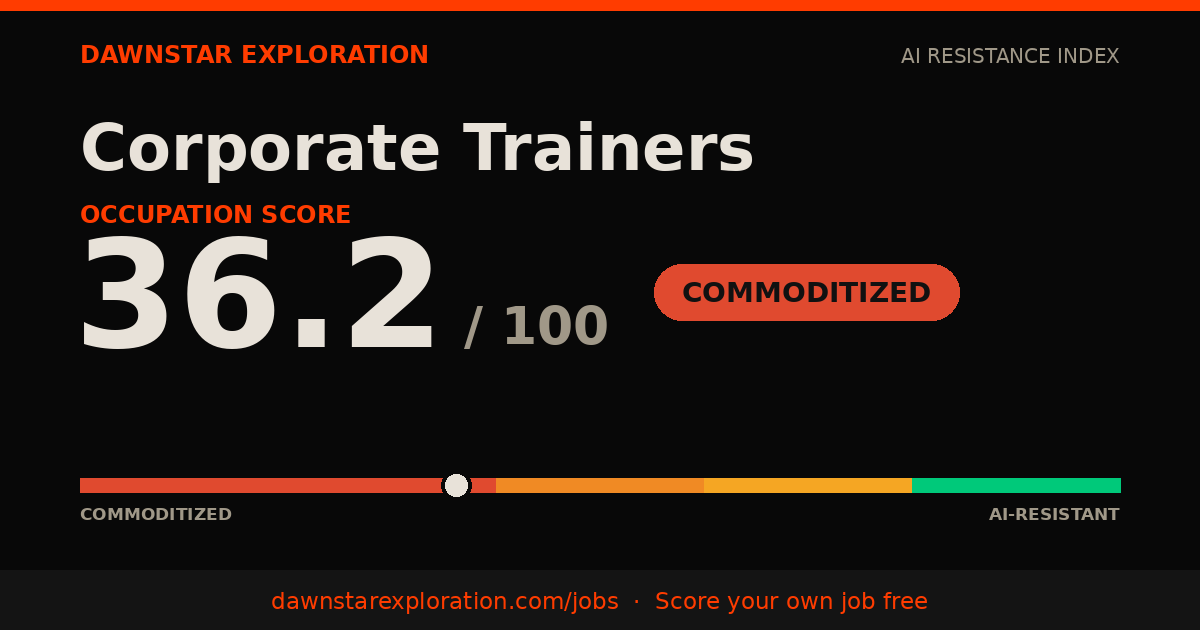
The routine parts, increasingly. Corporate training scores 36.2/100 on the AI Resistance Index (Commoditized): AI now builds courses, scripts and videos, and compliance and software training are moving to automated e-learning. Yet BLS projects training and development specialists to grow 11% from 2025 to 2035, much faster than average. Live facilitation, coaching and working out what a team actually needs are what hold up.
Higher is safer. Scored on six structural dimensions, weighted as shown below.
How the score breaks down
Each dimension is rated 1 (AI holds every advantage) to 5 (strong structural protection). A rating's contribution is (rating − 1) ÷ 4 × weight, so a 1 contributes nothing and a 5 contributes the full weight.
| Dimension | Weight | Rating | Points |
|---|---|---|---|
| Automation Replaceability | 25% | 2 / 5 | 6.25 |
| Regulatory & Liability Friction | 20% | 2 / 5 | 5 |
| Human Judgment Density | 15% | 3 / 5 | 7.5 |
| Physical-World Coupling | 15% | 3 / 5 | 7.5 |
| Trust & Relationship Lock-In | 15% | 3 / 5 | 7.5 |
| AI Capital Intensity | 10% | 2 / 5 | 2.5 |
| Total | 100% | 36.2 |
Points are exact; the scoring engine rounds the total to one decimal.
Why each dimension scores the way it does
Rated 2, the weakest dimension alongside licensing and capital. Building standard courses, writing scripts, quizzes and slides, and recording explainer videos are now fast with AI authoring tools and avatar video. Compliance modules, software tutorials and onboarding are the most exposed. It rates 2, not 1, because live workshops and coaching still need someone to run the room and respond to it.
Rated 2. No license is required to train employees, and certifications in the field are voluntary. Some training is mandated, such as workplace safety and, in some states, harassment prevention, and regulated industries must keep records that staff were trained. The rules usually require that training happened, not that a person delivered it, so an e-learning module often satisfies them.
Rated 3, the strongest dimension alongside physical presence and trust. Diagnosing why a team underperforms, deciding whether training is even the answer, and adapting a session when a room pushes back all take judgment. BLS lists assessing training needs with input from employees and managers among the core duties, and that work depends on reading an organization rather than following a template.
Rated 3. Much corporate training has moved online, but in-person sessions remain common for safety, equipment, sales and leadership skills, where practice and feedback in the room matter. BLS lists healthcare, hospitality and finance among the largest employers, industries where on-site training is routine. A trainer who runs live sessions is harder to replace than one who only records modules.
Rated 3. An internal trainer who knows the company's people, systems and culture becomes a trusted adviser to managers, and employees open up more to someone they know. External trainers and course vendors compete more on price and content, and those relationships are easier to replace with an off-the-shelf learning platform.
Rated 2. AI course builders, avatar video tools and AI tutors are sold as subscriptions, and the learning platforms many companies already pay for now include AI features. Connecting them to HR systems and keeping content accurate takes some effort, which keeps this off the floor, but cost is a small barrier for most employers.
Which training tasks AI takes first
BLS covers corporate trainers under Training and Development Specialists. The core tasks, sorted by how exposed each is to AI today:
Most exposed to AI
- Writing course scripts, slides and quizzes
- Producing training videos and e-learning modules
- Delivering standard compliance and software training
- Scheduling sessions and tracking completion
Most durable
- Working out with managers what a team actually needs
- Running live workshops and responding to the room
- Coaching people through practice and feedback
- Measuring whether training changed performance
The labor market today
| Median annual pay, training and development specialists (May 2025) | $69,280 |
| Jobs (2025) | 472,500 |
| Projected growth, 2025–35 | +11% (much faster than average) |
| Openings per year, on average | ≈46,000 |
| Typical entry-level education | Bachelor's degree |
BLS projects employment of training and development specialists to grow 11% from 2025 to 2035, much faster than average, with about 46,000 openings a year. It expects technological change and continuous upskilling, along with training on internal policies and regulatory compliance, to drive demand.
Demand for training is rising partly because AI keeps changing how people work. The score of 36.2 reflects how the job is delivered: standard courses are increasingly built and taught by software, so the growth favors trainers who diagnose needs and coach people over those who present slides.
How to raise your resistance
- Start with the diagnosis. Interviewing managers and employees to find what is really holding performance back is work AI cannot do from a course catalog.
- Teach what needs a room. Leadership, sales, safety and equipment training depend on practice and feedback that recorded modules handle poorly.
- Build with AI. Using AI tools to produce courses quickly lets you spend more of your time with learners and managers.
- Prove the results. Showing that training changed sales, safety or retention makes the case for keeping a person in charge of it.
This score rates the occupation as a whole. Your exposure depends on what you actually do all day. The free Job Safety score asks about your specific role and day-to-day work, then rates your role on the same six dimensions in about a minute.
Score my job — freeQuestions people ask
Will AI replace corporate trainers?
For standard courses and compliance training, increasingly. Trainers who run live sessions, coach and work out what a team needs hold up better. Corporate trainers score 36.2/100 on the AI Resistance Index (Commoditized).
Why does BLS project growth if the score is low?
BLS projects 11% growth for training and development specialists from 2025 to 2035, driven by upskilling and compliance training. The score measures how exposed the work is to AI, not how much training companies want, and AI lets each trainer deliver more.
How much do corporate trainers earn?
BLS reports a median of $69,280 for training and development specialists in May 2025, with a bachelor's degree as the typical entry-level education and some related work experience often expected.
Use this score on your site
Writing about this job and AI? You're welcome to show this score card. Copy the code below: it displays the card and credits the source.
Compare with
Sources and method
Ratings are Dawnstar Exploration's structural assessment using the six-dimension AI Resistance Index framework; labor-market figures are quoted from the sources above as published. This page describes an occupation, not any individual.