Will AI replace construction workers?
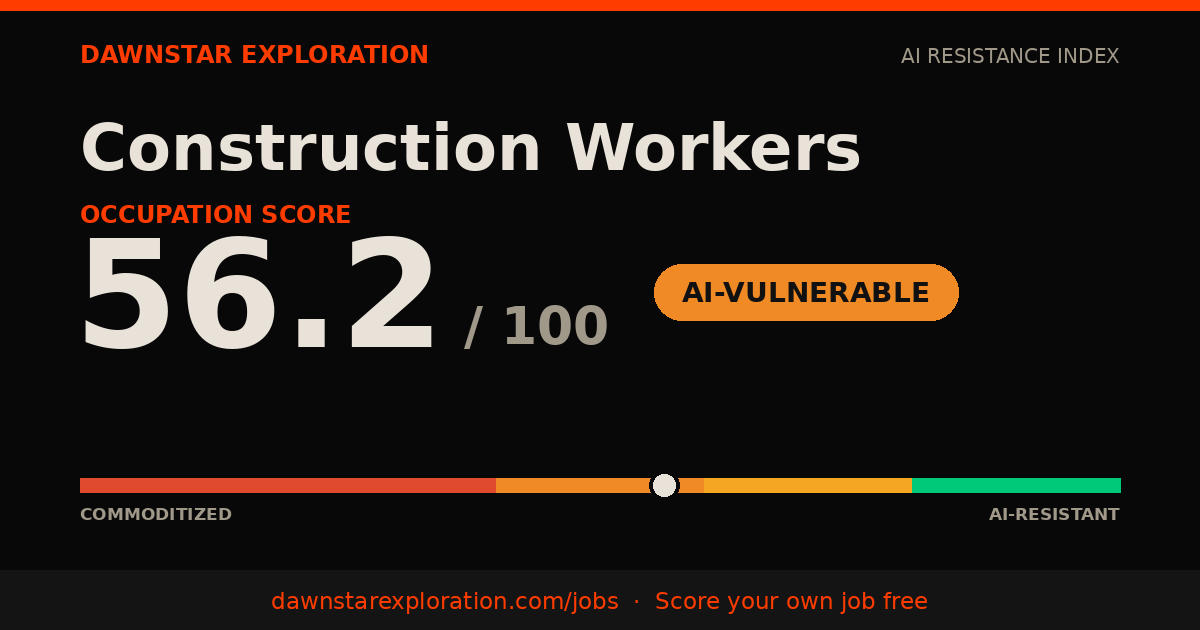
Not soon, but the work will shift toward whoever runs the machines. Construction workers score 56.2/100 on the AI Resistance Index (AI-Vulnerable). The physical side is what protects the job: every site is different, the ground is uneven, the weather changes and the tasks are varied. What is weaker is everything else. Laborers and helpers need little formal training, are easy to substitute for one another, and some of their repetitive tasks, such as digging and hauling, are the first that machines can take over.
Higher is safer. Scored on six structural dimensions, weighted as shown below.
How the score breaks down
Each dimension is rated 1 (AI holds every advantage) to 5 (strong structural protection). A rating's contribution is (rating − 1) ÷ 4 × weight, so a 1 contributes nothing and a 5 contributes the full weight.
| Dimension | Weight | Rating | Points |
|---|---|---|---|
| Automation Replaceability | 25% | 3 / 5 | 12.5 |
| Regulatory & Liability Friction | 20% | 3 / 5 | 10 |
| Human Judgment Density | 15% | 3 / 5 | 7.5 |
| Physical-World Coupling | 15% | 5 / 5 | 15 |
| Trust & Relationship Lock-In | 15% | 2 / 5 | 3.75 |
| AI Capital Intensity | 10% | 4 / 5 | 7.5 |
| Total | 100% | 56.2 |
Points are exact; the scoring engine rounds the total to one decimal.
Why each dimension scores the way it does
Rated 3. BLS lists the work of construction laborers and helpers as cleaning and preparing sites, loading and unloading materials, building scaffolding and bracing, digging trenches, operating power tools and assisting tradesworkers. Repetitive tasks such as trenching and hauling can be taken over by machines or by guided equipment, and the planning around them by software. The varied, hands-on work of helping several trades on a changing site is much harder to automate, which keeps this at 3.
Rated 3. BLS reports that construction laborers and helpers learn on the job, and that formal education is not typically required, so there is no licence barrier like the ones that protect doctors or electricians. What exists is a layer of site safety rules and contractor responsibility for what happens on a job. That is real, but weaker than a personal licence, so it earns the middle rating.
Rated 3. Much of a laborer's day follows instructions from a foreman or a tradesworker, but a site is full of small calls: what is safe to move, whether a trench wall is stable, which task to do first, and when to stop and ask. That is moderate judgment rather than the open-ended judgment of a profession that diagnoses or advises, so the rating sits in the middle.
Rated 5, the maximum. BLS describes the work as physically demanding, often outdoors in all weather, and wearing protective gear. Sites are muddy, cluttered and different every day, with no standard floor plan. A machine that could move through them and do the full range of laborer tasks safely is far from practical, and this is the dimension that holds the job up.
Rated 2. Clients hire a contractor, not the individual laborer, and laborers are largely interchangeable between employers. Loyalty is to the crew rather than to a client relationship that follows the worker. That makes it easy to switch workers, which is why this dimension offers little protection. Self-employed workers, a large share in this field, build their own client base and are an exception.
Rated 4. Building machines that can work across different construction sites safely is expensive, because every site, material and weather condition is different. Companies are building autonomous equipment, but it tends to suit large, repetitive earthmoving jobs rather than a small crew doing mixed tasks. The cost of covering the full range of laborer work keeps most of it human for now.
Which construction tasks machines take first
BLS lists what construction laborers and helpers typically do. Sorted by exposure:
Most exposed to AI
- Digging trenches, backfilling and compacting earth
- Loading and unloading building materials
- Cleaning and clearing the site of debris
- Operating a jackhammer, saw or drill on repetitive cuts
Most durable
- Assisting electricians, plumbers and other trades on varied tasks
- Building and taking apart scaffolding and temporary structures
- Working safely on uneven ground in changing weather
- Spotting hazards on a site that is different every day
The labor market today
| Median annual pay (May 2025) | $46,680 |
| Jobs (2025) | 1,674,400 |
| Projected change, 2025–35 | 6% (faster than average) |
| Openings per year, on average | ≈137,000 |
| Self-employed workers | 24% |
BLS projects employment of construction laborers and helpers to grow 6% from 2025 to 2035, faster than average, with about 137,000 openings a year. Many of those openings come from workers who move to other occupations or leave the labor force, for example to retire. Its outlook does not mention AI.
The occupation is large and varied: construction laborers make up the great majority of the 1,674,400 jobs, and helpers to electricians, plumbers, carpenters and other trades make up the rest. Pay and exposure differ by trade and by employer. A helper learning a skilled trade is on a different path from a general laborer, and this page scores the occupation as a whole.
How to raise your resistance
- Learn a trade. Helpers who move into a licensed trade such as electrical or plumbing work gain a licence, higher pay and work that is far harder to automate. It is the clearest way to move up from general labor.
- Learn to run the machines. Equipment that digs, hauls and compacts still needs an operator who understands the site. Being the person who directs the machine is safer than being the person it replaces.
- Get safety and equipment certifications. Training that shows you can work safely and operate specific equipment sets you apart from the general pool and makes you a more reliable hire for a contractor.
- Build your own client base. BLS reports that nearly a quarter of workers in this field are self-employed. Direct relationships with contractors and homeowners are the one source of lock-in available to a laborer.
This score rates the occupation as a whole. Your exposure depends on what you actually do all day. The free Job Safety score asks about your specific role and day-to-day work, then rates your role on the same six dimensions in about a minute.
Score my job — freeQuestions people ask
Will AI replace construction workers?
Not soon. Machines can take over some repetitive tasks such as digging and hauling, but sites are uneven, outdoors and different every day, and the work covers many trades. BLS projects 6% growth from 2025 to 2035.
Why do construction workers score lower than electricians or plumbers?
Electricians and plumbers hold licences, carry liability and build lasting client relationships. BLS reports that laborers learn on the job and formal education is not typically required, so workers are easier to substitute. The physical work protects both.
Which construction jobs are safest from AI?
Skilled, licensed trades and work that needs a person on a varied site, such as helping several trades or setting up scaffolding. The most exposed tasks are repetitive earthmoving, hauling and cleanup that guided equipment can handle.
Use this score on your site
Writing about this job and AI? You're welcome to show this score card. Copy the code below: it displays the card and credits the source.
Compare with
Sources and method
Ratings are Dawnstar Exploration's structural assessment using the six-dimension AI Resistance Index framework; labor-market figures are quoted from the sources above as published. This page describes an occupation, not any individual.