Will AI replace warehouse pickers?
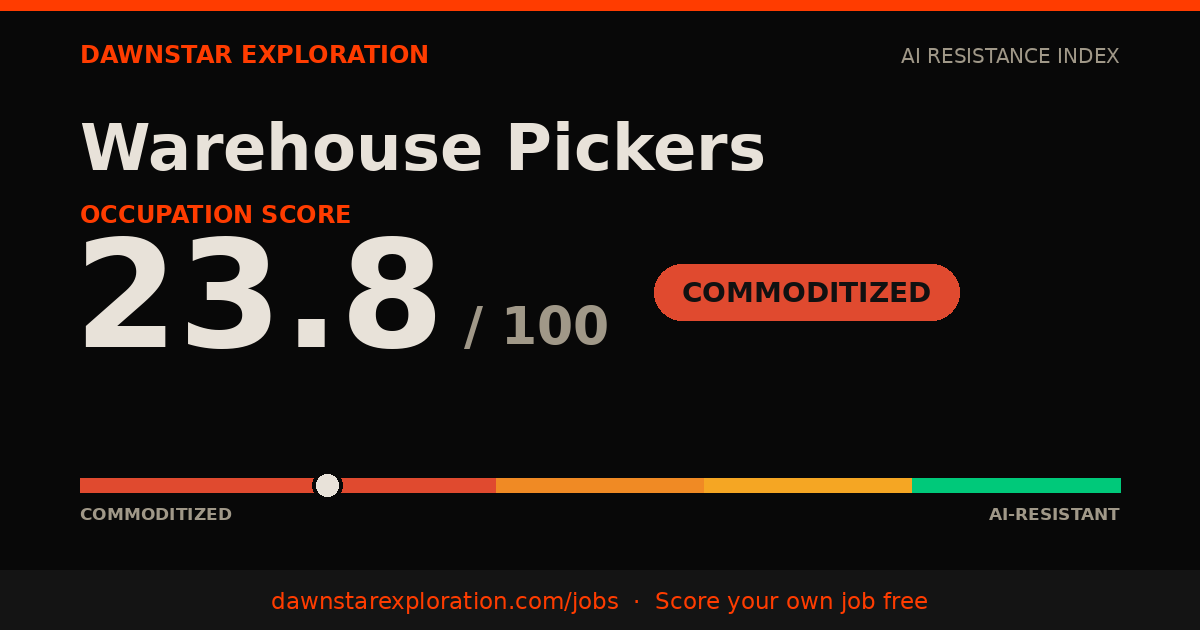
In large warehouses, increasingly yes. Warehouse picking scores 23.8/100 on the AI Resistance Index (Commoditized): the work is repetitive and happens in controlled spaces built around conveyors, sorting systems and robots. BLS still projects stockers and order fillers to grow 9% from 2025 to 2035, so the jobs aren't disappearing yet, but each one is getting easier to automate.
Higher is safer. Scored on six structural dimensions, weighted as shown below.
How the score breaks down
Each dimension is rated 1 (AI holds every advantage) to 5 (strong structural protection). A rating's contribution is (rating − 1) ÷ 4 × weight, so a 1 contributes nothing and a 5 contributes the full weight.
| Dimension | Weight | Rating | Points |
|---|---|---|---|
| Automation Replaceability | 25% | 1 / 5 | 0 |
| Regulatory & Liability Friction | 20% | 2 / 5 | 5 |
| Human Judgment Density | 15% | 2 / 5 | 3.75 |
| Physical-World Coupling | 15% | 3 / 5 | 7.5 |
| Trust & Relationship Lock-In | 15% | 1 / 5 | 0 |
| AI Capital Intensity | 10% | 4 / 5 | 7.5 |
| Total | 100% | 23.8 |
Points are exact; the scoring engine rounds the total to one decimal.
Why each dimension scores the way it does
Rated 1, the weakest dimension. Picking, sorting and packing follow fixed routes, standard items and measured targets, which makes them some of the most automated tasks in logistics: conveyors, sorting systems, mobile robots and robotic picking arms. BLS notes that some warehouses have installed high-speed conveyors and sorting systems.
Rated 2. Workplace safety rules apply wherever people work near machines and vehicles, but no licence is needed to pick orders and nothing in law requires a person to do it. Regulation shapes how the work is done, not who or what does it.
Rated 2. Most decisions are made by the warehouse system: which item, which bin, which route, which box. Handling damaged goods, mislabelled stock and other exceptions takes some judgment, but it is a small share of the day. Workers are measured mainly on speed and accuracy against system targets.
Rated 3. The work is entirely physical, but a warehouse is a controlled, repetitive environment, which is exactly where robots work best. That limits how much protection the physical side gives compared with work in homes or on building sites. Grasping items of every shape from mixed bins is still hard for robots, which keeps people on the floor.
Rated 1. Workers are interchangeable by design and often hired through agencies for peak seasons. No customer relationship ties the work to a particular person, so nothing in the relationship slows a switch to machines. Turnover is high, and operations are designed so that a new worker can be productive within days.
Rated 4, the strongest dimension. Automating a warehouse takes real capital: conveyors, sorting systems, robots, software and the integration work to make them run together. Large retailers can justify that investment and already run such systems at scale; smaller and older warehouses often cannot, which keeps people picking there for longer.
Which tasks AI takes first
BLS describes the duties of stockers and order fillers. Sorted by how exposed each is to AI and automation today:
Most exposed to AI
- Picking standard items from shelves to fill orders
- Sorting and routing packages
- Scanning and logging items in and out
- Moving products from storage to shelves or packing stations
Most durable
- Handling damaged, oversized or unusual items
- Sorting out exceptions such as mislabelled stock and problem orders
- Keeping automated equipment running and clearing jams
- Work in small or irregular sites that are not built for robots
The labor market today
| Median annual pay, stockers and order fillers (May 2025) | $37,330 |
| Jobs, stockers and order fillers (2025) | 2,804,300 |
| Projected growth, stockers and order fillers, 2025–35 | +9% |
| Openings per year, all hand laborers and material movers | ≈904,200 |
| Typical entry-level education | No formal educational credential |
BLS projects stockers and order fillers to grow 9% from 2025 to 2035, an increase of about 250,700 jobs. In the same occupation group, it expects automation to reduce jobs for machine feeders and notes that packers have fewer manual tasks as warehouse technology evolves.
Growth and exposure point in different directions. Online orders keep adding warehouse jobs even as each warehouse needs fewer people per order. The score of 23.8 measures the second effect: how much of the work machines can structurally take over.
How to raise your resistance
- Move to the machines. Maintenance technicians and operators who keep conveyors and robots running are needed more as automation spreads.
- Learn the warehouse systems. Inventory and warehouse management software skills move you toward supervising the process instead of being one step in it.
- Take the exceptions. Damaged goods, returns, oversized items and problem orders are the work robots handle worst.
- Step into supervision. Shift leads coordinate people, machines and deadlines, which is judgment work that automation adds rather than removes.
This score rates the occupation as a whole. Your exposure depends on what you actually do all day. The free Job Safety score asks about your specific role and day-to-day work, then rates your role on the same six dimensions in about a minute.
Score my job — freeQuestions people ask
Will robots and AI replace warehouse pickers?
Increasingly, in large warehouses. Picking is repetitive work in a controlled space, the setting automation suits best, which is why warehouse pickers score 23.8/100. BLS still projects these jobs to grow as online orders rise.
Are warehouse jobs still a good option?
BLS projects 9% growth for stockers and order fillers from 2025 to 2035, with a median pay of $37,330 in May 2025. The safer path is toward maintaining and supervising automated systems.
What part of warehouse work is most exposed?
Routine picking, sorting and scanning of standard items. Those tasks are what conveyors, sorting systems and picking robots are built for, which is why automation replaceability rates 1 of 5.
Use this score on your site
Writing about this job and AI? You're welcome to show this score card. Copy the code below: it displays the card and credits the source.
Compare with
Sources and method
Ratings are Dawnstar Exploration's structural assessment using the six-dimension AI Resistance Index framework; labor-market figures are quoted from the sources above as published. This page describes an occupation, not any individual.