Will AI replace structural engineers?
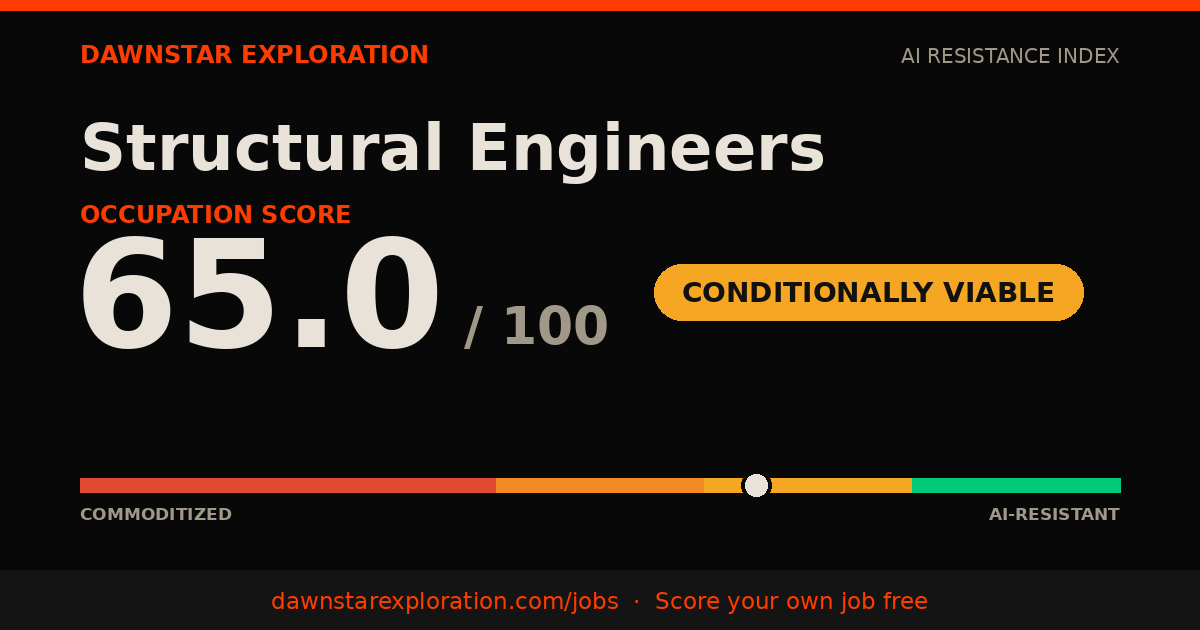
Not the part that carries the liability. Structural engineering scores 65.0/100 on the AI Resistance Index (Conditionally Viable), a little above civil engineering overall: software and AI already handle much of the modelling and calculation, but a licensed engineer must certify that a building or bridge will stand, and that responsibility can't be handed to a model.
Higher is safer. Scored on six structural dimensions, weighted as shown below.
How the score breaks down
Each dimension is rated 1 (AI holds every advantage) to 5 (strong structural protection). A rating's contribution is (rating − 1) ÷ 4 × weight, so a 1 contributes nothing and a 5 contributes the full weight.
| Dimension | Weight | Rating | Points |
|---|---|---|---|
| Automation Replaceability | 25% | 3 / 5 | 12.5 |
| Regulatory & Liability Friction | 20% | 5 / 5 | 20 |
| Human Judgment Density | 15% | 4 / 5 | 11.25 |
| Physical-World Coupling | 15% | 4 / 5 | 11.25 |
| Trust & Relationship Lock-In | 15% | 3 / 5 | 7.5 |
| AI Capital Intensity | 10% | 2 / 5 | 2.5 |
| Total | 100% | 65.0 |
Points are exact; the scoring engine rounds the total to one decimal.
Why each dimension scores the way it does
Rated 3. Structural analysis software already runs load calculations and models, and AI tools are starting to generate and check design options. Interpreting those results, spotting where a model is wrong and deciding what is safe enough remain human work, which keeps this from rating lower.
Rated 5, the strongest dimension. Structural designs must be approved by a licensed Professional Engineer, building codes govern every element, and the engineer who certifies a design is accountable if the structure fails. That personal liability is the core protection of the job.
Rated 4. Every structure is different: loads, materials, soil, existing conditions and budget all interact. BLS describes structural engineers as designing and assessing projects such as buildings, bridges and dams for strength and durability, and that assessment rests on experienced judgment.
Rated 4. Inspecting existing structures, assessing damage and checking work during construction keep the job tied to physical buildings and infrastructure, even though much of the design and analysis happens at a desk. After storms, fires or earthquakes, structural engineers are the ones sent to judge whether a building is safe to enter.
Rated 3. Architects and contractors return to structural engineers they trust on complex or unusual projects, because a bad call is expensive. Routine work is often bid competitively, which limits lock-in across the occupation. An engineer who has signed off on an architect's past projects without problems tends to get the next one.
Rated 2, the weakest dimension. Analysis and design software is widely available and affordable for small firms, so the cost of the tools offers little protection. The licence and the liability are what keep the work with a person. Small firms run the same tools as large ones.
Which tasks AI takes first
BLS covers structural engineers within civil engineers. The core tasks, sorted by how exposed each is to AI today:
Most exposed to AI
- Running load calculations and structural models
- Producing drawings and design documentation
- Checking routine designs against standard code provisions
- Preparing estimates and reports
Most durable
- Certifying that a design is safe as the licensed engineer
- Inspecting existing and damaged structures
- Judging unusual loads, materials and site conditions
- Answering to building officials, architects and contractors
The labor market today
| Median annual pay, civil engineers (May 2025) | $100,840 |
| Jobs, civil engineers including structural (2025) | 380,600 |
| Projected growth, civil engineers, 2025–35 | +6% |
| Openings per year, civil engineers | ≈22,700 |
| Typical entry-level education | Bachelor's degree |
BLS has no separate category for structural engineers; it describes them within civil engineers, who are projected to grow 6% from 2025 to 2035, faster than average. Engineers who approve plans or serve the public directly typically must hold a licence.
Structural engineering scores a little higher than civil engineering overall because the liability for whether a structure stands is direct and personal. The modelling around that decision is increasingly done by software, which is why the score is 65.0 and not higher.
How to raise your resistance
- Get licensed. The licence is what lets you certify designs. That signature is the part of the work AI cannot take.
- Own the hard cases. Retrofits, damaged structures and unusual loads are where models are least reliable and judgment matters most.
- Use AI to check, not to decide. Let software generate and test options faster, and keep the final engineering judgment and the sign-off.
- Build relationships with architects. Repeat work on complex projects comes from architects and contractors who trust your calls.
This score rates the occupation as a whole. Your exposure depends on what you actually do all day. The free Job Safety score asks about your specific role and day-to-day work, then rates your role on the same six dimensions in about a minute.
Score my job — freeQuestions people ask
Will AI replace structural engineers?
No. Someone licensed has to certify that a structure is safe and answer for it if it fails. AI and software handle more of the modelling, which is why structural engineers score 65.0/100 rather than higher.
Is structural engineering a good career?
BLS counts structural engineers within civil engineers, projected to grow 6% from 2025 to 2035 with a median pay of $100,840 in May 2025. The licensed path is the most protected one.
What part of structural engineering does AI affect?
Load calculations, modelling and drawings. Analysis software and AI already do much of this, so the value shifts to judging the results and signing off.
Use this score on your site
Writing about this job and AI? You're welcome to show this score card. Copy the code below: it displays the card and credits the source.
Compare with
Sources and method
Ratings are Dawnstar Exploration's structural assessment using the six-dimension AI Resistance Index framework; labor-market figures are quoted from the sources above as published. This page describes an occupation, not any individual.