Will AI replace photographers?
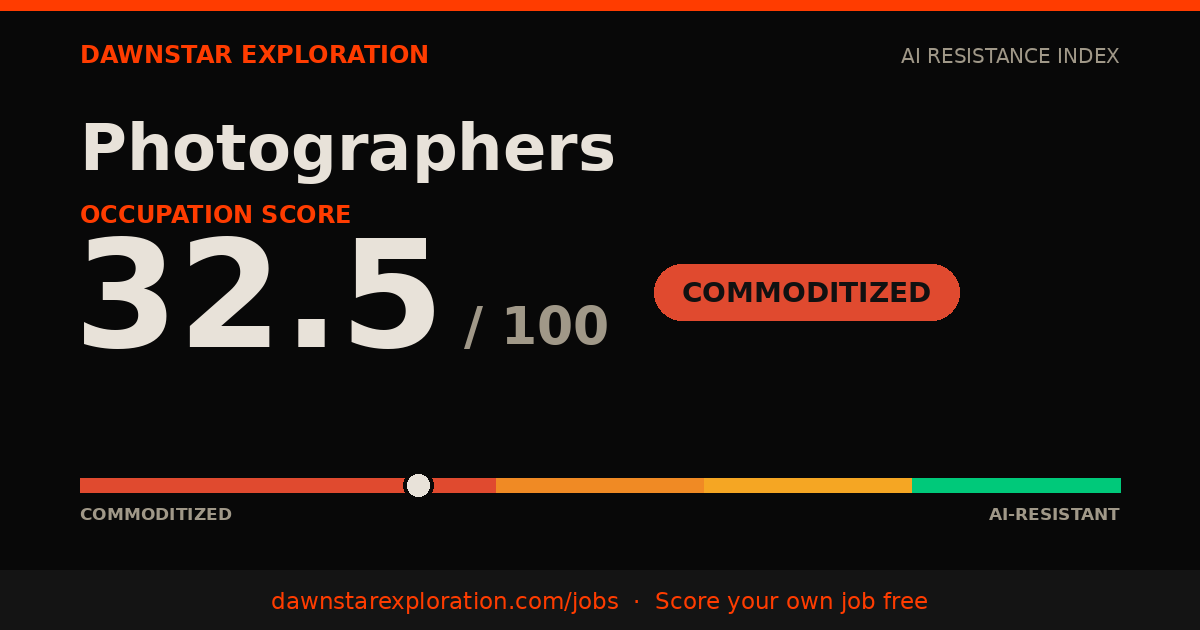
Not the photographer who has to be there. Photography scores 32.5/100 on the AI Resistance Index (Commoditized): BLS expects AI-generated images to partially replace stock photos, and simple product shots are going the same way, but weddings, events, portraits and on-location work still need someone with a camera in the room.
Higher is safer. Scored on six structural dimensions, weighted as shown below.
How the score breaks down
Each dimension is rated 1 (AI holds every advantage) to 5 (strong structural protection). A rating's contribution is (rating − 1) ÷ 4 × weight, so a 1 contributes nothing and a 5 contributes the full weight.
| Dimension | Weight | Rating | Points |
|---|---|---|---|
| Automation Replaceability | 25% | 2 / 5 | 6.25 |
| Regulatory & Liability Friction | 20% | 1 / 5 | 0 |
| Human Judgment Density | 15% | 3 / 5 | 7.5 |
| Physical-World Coupling | 15% | 4 / 5 | 11.25 |
| Trust & Relationship Lock-In | 15% | 3 / 5 | 7.5 |
| AI Capital Intensity | 10% | 1 / 5 | 0 |
| Total | 100% | 32.5 |
Points are exact; the scoring engine rounds the total to one decimal.
Why each dimension scores the way it does
Rated 2. Stock, product and illustrative images are the easiest to replace, and BLS expects AI-generated images to partially replace stock photography. Editing and retouching are increasingly automated too. Photographing real people and real events cannot be generated, which keeps this above the floor.
Rated 1, the weakest dimension. No licence is required, anyone can sell photographs, and nothing requires a human to create an image. Copyright and model releases govern how images are used, not who or what makes them. Even news and documentary photography relies on editorial standards rather than any licence.
Rated 3. Composition, light, timing and directing people take real skill and taste. Clients increasingly compare results with what software can produce, though, and much commercial work follows a brief that leaves little room for judgment. The photographers who hold up best are those whose eye clients specifically seek out.
Rated 4, the strongest dimension. Weddings, events, portraits, real estate and news happen in physical places at specific times, and the photographer has to be there. That presence is the main protection in the job, and no image generator can provide it.
Rated 3. Clients book photographers for important moments based on reputation and referrals, and BLS reports that about two-thirds of photographers are self-employed, so their client relationships are their business. Commercial clients switch more easily. Weddings and family portraits in particular are booked on personal recommendation.
Rated 1. AI image generators and automatic editing tools are cheap or free, so producing an image costs almost nothing. There is no capital barrier protecting generic photography, only the need to be present for real moments. Good cameras in phones lower the barrier further.
Which tasks AI takes first
BLS describes the core duties of photographers. Sorted by how exposed each is to AI today:
Most exposed to AI
- Stock and illustrative images, which BLS expects AI-generated images to partly replace
- Simple product and catalogue shots
- Retouching and basic editing
- Managing and tagging image archives
Most durable
- Photographing weddings, events and people in person
- Directing subjects and putting them at ease
- On-location work in real places and conditions
- Building a client base through reputation and referrals
The labor market today
| Median annual pay (May 2025) | $44,660 |
| Jobs (2025) | 145,000 |
| Projected change, 2025–35 | −1% |
| Openings per year, on average | ≈10,700 |
| Typical entry-level education | High school diploma or equivalent |
BLS projects photographer jobs to decline 1% from 2025 to 2035. It expects smartphones to reduce the need for professional photographers and AI-generated images to partially replace stock photos, while demand for portraits and commercial work continues and self-employment grows.
About two-thirds of photographers are self-employed, so the shift shows up as lost bookings rather than layoffs. The score of 32.5 reflects that generic images are commoditized while being there in person is not. Wedding, event and portrait work remains the most protected.
How to raise your resistance
- Be where the moment is. Weddings, events, portraits and on-location work need a person present, which no generator can replace.
- Sell the experience. Clients pay to be directed, put at ease and photographed well on a day that matters. Make that the product, not the files.
- Use AI in the edit. Let AI handle culling and retouching so you can take more bookings.
- Specialize. Niches that need access, trust or technical skill, such as architectural, medical, legal or aerial work, are harder to replace.
This score rates the occupation as a whole. Your exposure depends on what you actually do all day. The free Job Safety score asks about your specific role and day-to-day work, then rates your role on the same six dimensions in about a minute.
Score my job — freeQuestions people ask
Will AI replace photographers?
It is replacing stock and simple product photography. Photographing real people, events and places still needs someone there, which is why photographers score 32.5/100.
Is photography still a good career?
BLS projects a 1% decline from 2025 to 2035, with a median pay of $44,660 in May 2025 and about 10,700 openings a year. Most photographers are self-employed, so the career depends on building clients in work AI cannot do.
Which photography is most exposed to AI?
Stock, illustrative and simple product images. BLS expects AI-generated images to partially replace stock photos, and AI capital intensity rates 1 of 5 because generating images costs almost nothing.
Use this score on your site
Writing about this job and AI? You're welcome to show this score card. Copy the code below: it displays the card and credits the source.
Compare with
Sources and method
Ratings are Dawnstar Exploration's structural assessment using the six-dimension AI Resistance Index framework; labor-market figures are quoted from the sources above as published. This page describes an occupation, not any individual.