Will AI replace medical scribes?
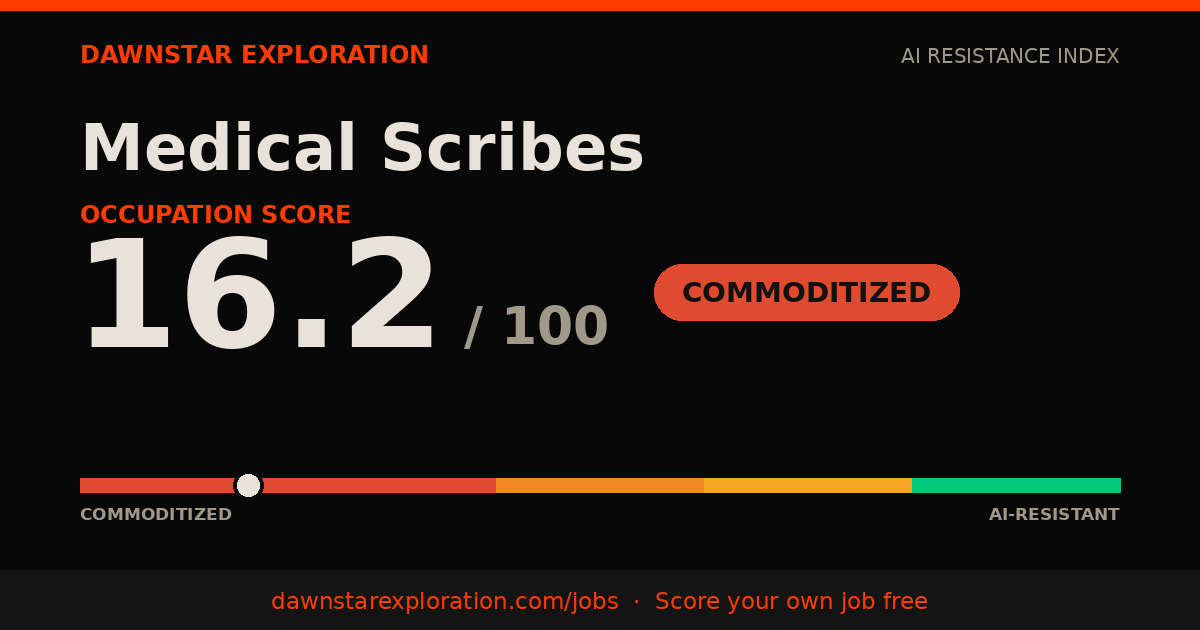
It's one of the most exposed jobs in the index. Medical scribing scores 16.2/100 on the AI Resistance Index (Commoditized): AI scribes now listen to a visit and draft the clinical note, the task a human scribe was hired to do. BLS projects the closest occupation it tracks, medical transcriptionists, to decline from 2025 to 2035.
Higher is safer. Scored on six structural dimensions, weighted as shown below.
How the score breaks down
Each dimension is rated 1 (AI holds every advantage) to 5 (strong structural protection). A rating's contribution is (rating − 1) ÷ 4 × weight, so a 1 contributes nothing and a 5 contributes the full weight.
| Dimension | Weight | Rating | Points |
|---|---|---|---|
| Automation Replaceability | 25% | 1 / 5 | 0 |
| Regulatory & Liability Friction | 20% | 2 / 5 | 5 |
| Human Judgment Density | 15% | 2 / 5 | 3.75 |
| Physical-World Coupling | 15% | 2 / 5 | 3.75 |
| Trust & Relationship Lock-In | 15% | 2 / 5 | 3.75 |
| AI Capital Intensity | 10% | 1 / 5 | 0 |
| Total | 100% | 16.2 |
Points are exact; the scoring engine rounds the total to one decimal.
Why each dimension scores the way it does
Rated 1, the weakest dimension. A scribe's core job is turning a patient visit into a structured note in the health record. AI scribes that listen to the conversation and draft the note are now sold to clinics and hospitals, and BLS notes that advances in speech recognition and natural language processing let physicians document encounters themselves.
Rated 2, the strongest dimension. Health privacy rules and the accuracy of the medical record matter, but the physician reviews and signs the note and is responsible for it. No licence is required to work as a scribe, so regulation does little to keep a person in the role.
Rated 2. Knowing what belongs in a note and using correct medical terminology takes training, but the clinical judgment belongs to the physician. The scribe records decisions rather than making them. When something is unclear, the scribe asks the physician rather than deciding, which keeps the role closely tied to someone else's judgment.
Rated 2. Many scribes work in exam rooms or emergency departments, but the task itself is documentation, and remote and virtual scribing were common even before AI scribes arrived. Being in the room is helpful, not essential. AI scribes need only a microphone in the room.
Rated 2. A physician may prefer a scribe they work well with, but the relationship is with the clinic's workflow, and scribes are often supplied through staffing companies. Little ties the work to a particular person. Clinics that switch to AI scribes can do so without disrupting a relationship patients notice.
Rated 1. AI scribe tools are sold as subscriptions and offered inside major health-record systems, so replacing a human scribe takes no unusual capital. Cost is no barrier to adoption. Health systems that already use those records can switch on AI documentation without building anything new, which speeds adoption across a whole organization.
Which tasks AI takes first
BLS does not cover medical scribes; these are the core tasks of the role, sorted by how exposed each is to AI today:
Most exposed to AI
- Documenting the visit as the physician and patient talk
- Entering history, exam findings and plans into the health record
- Drafting referral letters and visit summaries
- Looking up results and prior notes for the physician
Most durable
- Supporting physicians in fast-moving settings such as emergency departments
- Catching errors and omissions before the physician signs
- Checking and correcting AI-drafted notes
- Helping with patient flow and coordination during a shift
The labor market today
| Median annual pay, medical transcriptionists (May 2025) | $40,410 |
| Jobs, medical transcriptionists (2025) | 42,000 |
| Projected change, medical transcriptionists, 2025–35 | −4% |
| Openings per year, medical transcriptionists | ≈6,200 |
| Typical entry-level education, medical transcriptionists | Postsecondary nondegree award |
BLS has no category for medical scribes; the closest is Medical Transcriptionists (SOC 31-9094), projected to decline 4% from 2025 to 2035. BLS notes that advances in speech recognition and natural language processing let physicians document patient encounters themselves.
Many scribes take the job as a step toward medical, nursing or physician assistant school, and that path still has value. As a long-term role, the score of 16.2 reflects that AI now does the central task.
How to raise your resistance
- Use it as a stepping stone. Clinical exposure as a scribe still helps applications to medical, nursing and physician assistant programs.
- Become the AI note reviewer. Clinics adopting AI scribes need people who check drafts, fix errors and maintain templates.
- Move toward hands-on roles. Medical assistant, nursing and other clinical roles add the patient contact and licensing that documentation lacks.
- Learn health-record systems deeply. EHR support and clinical informatics put documentation skills to work on the systems themselves.
This score rates the occupation as a whole. Your exposure depends on what you actually do all day. The free Job Safety score asks about your specific role and day-to-day work, then rates your role on the same six dimensions in about a minute.
Score my job — freeQuestions people ask
Will AI replace medical scribes?
Largely, yes. AI scribes now listen to visits and draft clinical notes, which is the core of the job. Medical scribes score 16.2/100, among the lowest in the index.
Is medical scribing still worth doing?
As a step toward medical, nursing or physician assistant school, it still offers clinical exposure. As a long-term career it is highly exposed: BLS projects medical transcriptionists, the closest occupation it tracks, to decline 4% from 2025 to 2035.
What part of a scribe's job does AI do?
Listening to the visit, drafting the note and entering it into the health record. That is why automation replaceability rates 1 of 5.
Use this score on your site
Writing about this job and AI? You're welcome to show this score card. Copy the code below: it displays the card and credits the source.
Compare with
Sources and method
Ratings are Dawnstar Exploration's structural assessment using the six-dimension AI Resistance Index framework; labor-market figures are quoted from the sources above as published. This page describes an occupation, not any individual.