Will AI replace interior designers?
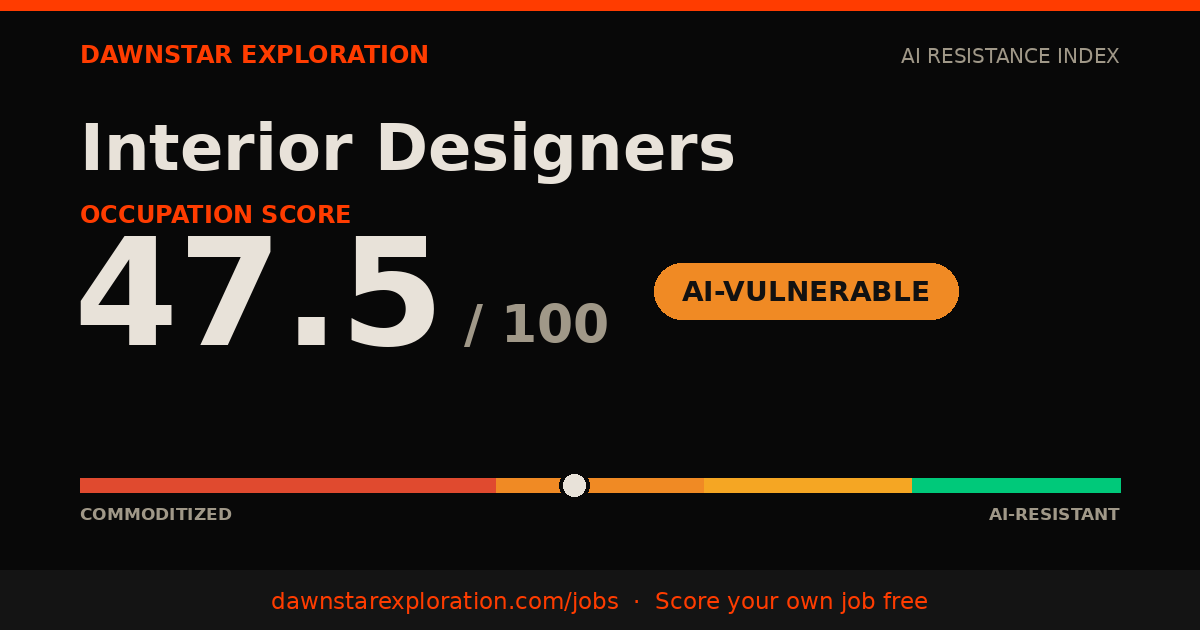
Not the whole job, but the visual part is increasingly exposed. Interior design scores 47.5/100 on the AI Resistance Index (AI-Vulnerable): AI tools now produce room layouts, mood boards and realistic renderings in minutes, but measuring real spaces, meeting codes and accessibility needs, managing contractors and earning a client's trust still need a designer.
Higher is safer. Scored on six structural dimensions, weighted as shown below.
How the score breaks down
Each dimension is rated 1 (AI holds every advantage) to 5 (strong structural protection). A rating's contribution is (rating − 1) ÷ 4 × weight, so a 1 contributes nothing and a 5 contributes the full weight.
| Dimension | Weight | Rating | Points |
|---|---|---|---|
| Automation Replaceability | 25% | 2 / 5 | 6.25 |
| Regulatory & Liability Friction | 20% | 2 / 5 | 5 |
| Human Judgment Density | 15% | 4 / 5 | 11.25 |
| Physical-World Coupling | 15% | 4 / 5 | 11.25 |
| Trust & Relationship Lock-In | 15% | 4 / 5 | 11.25 |
| AI Capital Intensity | 10% | 2 / 5 | 2.5 |
| Total | 100% | 47.5 |
Points are exact; the scoring engine rounds the total to one decimal.
Why each dimension scores the way it does
Rated 2, the weakest dimension. Concept boards, furniture layouts and photorealistic renderings are now quick to produce with AI tools, and clients can try them themselves. BLS notes designers already use CAD for most drawings and BIM for 3D visualizations, the parts of the work software handles best.
Rated 2. Rules vary by state: some allow only licensed designers to do interior design work, some restrict only the title, and some have no restrictions. Building codes and accessibility requirements apply to the finished space, but most residential design needs no licence.
Rated 4. Turning a client's taste, budget and habits into a space that works, choosing materials that hold up, and resolving conflicts between what looks good and what is practical take judgment that clients pay for and that a generated image skips. Generated images skip those trade-offs entirely.
Rated 4. Designers measure real spaces, deal with existing conditions, and coordinate and oversee installation with contractors, which BLS lists among the duties. A rendering is not a finished room, and getting from one to the other happens on site. Problems found on site are solved there.
Rated 4. Clients invite designers into their homes and businesses and spend large sums on their advice, so they choose on trust and referrals and come back for the next project. That relationship is hard for an app to replace. Repeat clients often follow a designer for years.
Rated 2. AI design and rendering tools are inexpensive subscriptions, so producing attractive designs is cheap for anyone. Delivering the finished space is what still costs, and that is where designers keep their value. Homeowners can now try ideas on their own rooms with free or cheap apps before calling anyone.
Which tasks AI takes first
BLS describes the core duties of interior designers. Sorted by how exposed each is to AI today:
Most exposed to AI
- Producing mood boards and concept options
- Drafting floor plans and furniture layouts
- Creating 3D renderings and visualizations
- Sourcing products and building specification lists
Most durable
- Understanding how a client actually lives or works in a space
- Measuring sites and dealing with existing conditions
- Meeting building codes and accessibility needs
- Coordinating contractors and overseeing installation
The labor market today
| Median annual pay (May 2025) | $67,190 |
| Jobs (2025) | 97,100 |
| Projected growth, 2025–35 | +3% |
| Openings per year, on average | ≈7,700 |
| Typical entry-level education | Bachelor's degree |
BLS projects 3% growth for interior designers from 2025 to 2035, about as fast as average, driven by renovation work and a greater focus on building codes and accessible spaces. The BLS outlook does not discuss AI.
Clients can now generate attractive concepts themselves, which pushes designers' value toward delivery: the site, the contractors and the decisions. The score of 47.5 reflects that split between exposed concept work and durable delivery. Designers who work on commercial, healthcare or hospitality projects face the most regulation and the least competition from consumer apps.
How to raise your resistance
- Sell delivery, not drawings. Measuring, specifying, managing contractors and getting the room built is the part clients cannot do with an app.
- Get licensed where it counts. In states that regulate the practice or the title, the credential separates you from anyone with a rendering tool.
- Specialize in regulated spaces. Healthcare, hospitality and commercial interiors bring codes and accessibility requirements that raise the stakes of mistakes.
- Use AI for concepts. Generate options quickly and spend your time on the choices and the build. Clients judge you on the finished room.
This score rates the occupation as a whole. Your exposure depends on what you actually do all day. The free Job Safety score asks about your specific role and day-to-day work, then rates your role on the same six dimensions in about a minute.
Score my job — freeQuestions people ask
Will AI replace interior designers?
AI is taking over concepts, layouts and renderings. Understanding clients, working with real spaces and managing the build hold up, which is why interior designers score 47.5/100.
Is interior design still a good career?
BLS projects 3% growth from 2025 to 2035, with a median pay of $67,190 in May 2025 and about 7,700 openings a year. The safer path is delivery and regulated commercial work rather than concept design.
Which interior design tasks are most exposed to AI?
Mood boards, layouts and renderings. AI tools now produce these in minutes, which is why automation replaceability rates 2 of 5.
Use this score on your site
Writing about this job and AI? You're welcome to show this score card. Copy the code below: it displays the card and credits the source.
Compare with
Sources and method
Ratings are Dawnstar Exploration's structural assessment using the six-dimension AI Resistance Index framework; labor-market figures are quoted from the sources above as published. This page describes an occupation, not any individual.