Will AI replace construction project managers?
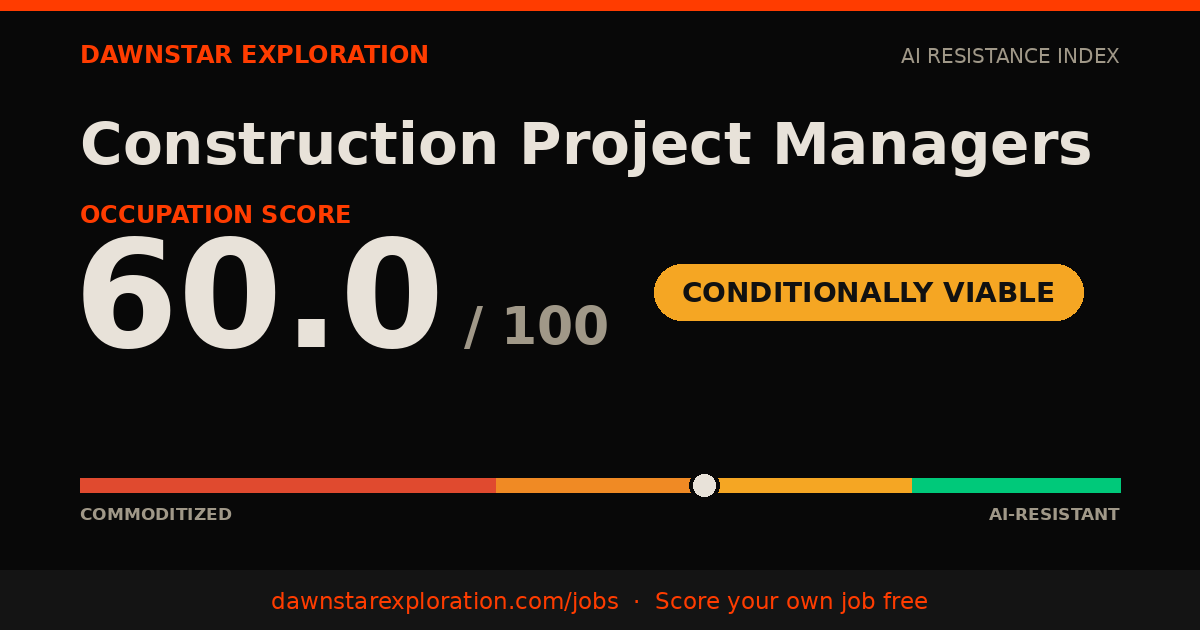
Not the job site. Construction project management scores 60.0/100 on the AI Resistance Index (Conditionally Viable): AI and planning software increasingly handle estimates, schedules and paperwork, but running a site, coordinating trades and answering for safety and code compliance still need a person on the ground.
Higher is safer. Scored on six structural dimensions, weighted as shown below.
How the score breaks down
Each dimension is rated 1 (AI holds every advantage) to 5 (strong structural protection). A rating's contribution is (rating − 1) ÷ 4 × weight, so a 1 contributes nothing and a 5 contributes the full weight.
| Dimension | Weight | Rating | Points |
|---|---|---|---|
| Automation Replaceability | 25% | 2 / 5 | 6.25 |
| Regulatory & Liability Friction | 20% | 4 / 5 | 15 |
| Human Judgment Density | 15% | 3 / 5 | 7.5 |
| Physical-World Coupling | 15% | 5 / 5 | 15 |
| Trust & Relationship Lock-In | 15% | 4 / 5 | 11.25 |
| AI Capital Intensity | 10% | 3 / 5 | 5 |
| Total | 100% | 60.0 |
Points are exact; the scoring engine rounds the total to one decimal.
Why each dimension scores the way it does
Rated 2, the weakest dimension. A large share of the role is estimating, scheduling, budgeting and documentation, and BLS notes that construction managers already use cost-estimating and planning software. AI tools are getting good at exactly this office side of the job, which is why it rates low.
Rated 4. Projects must meet building and safety codes, some states require construction managers to be licensed, and the manager answers for legal compliance and for safety on site. Those obligations keep an accountable person in charge of every project. Inspections at each stage keep that accountability visible.
Rated 3. Choosing subcontractors, resolving problems on site and trading off cost, time and quality all take judgment. Much of the work, though, follows established processes and documentation that software can carry. Experienced managers earn their pay when weather, late deliveries or design changes force decisions that no schedule anticipated.
Rated 5, the strongest dimension. The work happens on construction sites: walking the job, solving problems as they appear and keeping crews and deliveries coordinated. No software can be in the field for you, and no robot runs a site. Being there is the job.
Rated 4. Owners, architects and subcontractors return to managers who deliver on time and on budget. A good manager's network of reliable trades and suppliers is hard to replace and travels with them from job to job. Subcontractors, in turn, prioritize managers who pay on time and run organized sites.
Rated 3. Replacing on-site management would need robotics and site sensing far beyond today's tools. The software that exists supports managers rather than substituting for them, though it is cheap enough that every firm can use it. The gap between scheduling software and a working site manager remains very large.
Which tasks AI takes first
BLS describes the core duties of construction managers. Sorted by how exposed each is to AI today:
Most exposed to AI
- Preparing cost estimates and budgets
- Building and updating schedules
- Writing progress reports and documentation
- Tracking materials, orders and change requests
Most durable
- Running the site day to day and solving problems as they arise
- Coordinating architects, engineers and trades
- Making sure work meets building and safety codes
- Managing client and subcontractor relationships
The labor market today
| Median annual pay (May 2025) | $114,990 |
| Jobs (2025) | 609,100 |
| Projected growth, 2025–35 | +9% |
| Openings per year, on average | ≈49,700 |
| Typical entry-level education | Bachelor's degree |
BLS projects 9% growth for construction managers from 2025 to 2035, much faster than average, an increase of about 55,200 jobs. It notes that technology makes construction managers more productive; it does not discuss AI.
The office side of the role is exposed and the site side is not. The score of 60.0 reflects a job where AI can take over the paperwork while the person on site stays essential. Managers who combine site leadership with fluency in the new estimating and scheduling tools will run more projects with fewer people around them.
How to raise your resistance
- Own the site, not the spreadsheet. Time on site, safety leadership and problem solving are the parts of the job no software does. Crews and inspectors deal with the person who shows up.
- Let AI build the first schedule. Use AI and planning tools for estimates, schedules and reports, and spend the time saved in the field.
- Get licensed or certified. Where your state licenses construction managers, the licence adds a layer of accountability that protects the role.
- Build your bench of trades. Reliable subcontractors who answer your calls are a relationship asset AI cannot replicate.
This score rates the occupation as a whole. Your exposure depends on what you actually do all day. The free Job Safety score asks about your specific role and day-to-day work, then rates your role on the same six dimensions in about a minute.
Score my job — freeQuestions people ask
Will AI replace construction project managers?
Not on site. AI is taking over estimating, scheduling and paperwork, but someone still has to run the job, coordinate trades and answer for safety. The role scores 60.0/100.
Is construction management a good career?
BLS projects 9% growth from 2025 to 2035, much faster than average, with a median pay of $114,990 in May 2025 and about 49,700 openings a year.
Which construction management tasks does AI affect most?
Estimates, schedules, budgets and reports: the office side of the role. That is why automation replaceability rates only 2 of 5, while physical-world coupling rates 5 of 5.
Use this score on your site
Writing about this job and AI? You're welcome to show this score card. Copy the code below: it displays the card and credits the source.
Compare with
Sources and method
Ratings are Dawnstar Exploration's structural assessment using the six-dimension AI Resistance Index framework; labor-market figures are quoted from the sources above as published. This page describes an occupation, not any individual.