Will AI replace civil engineers?
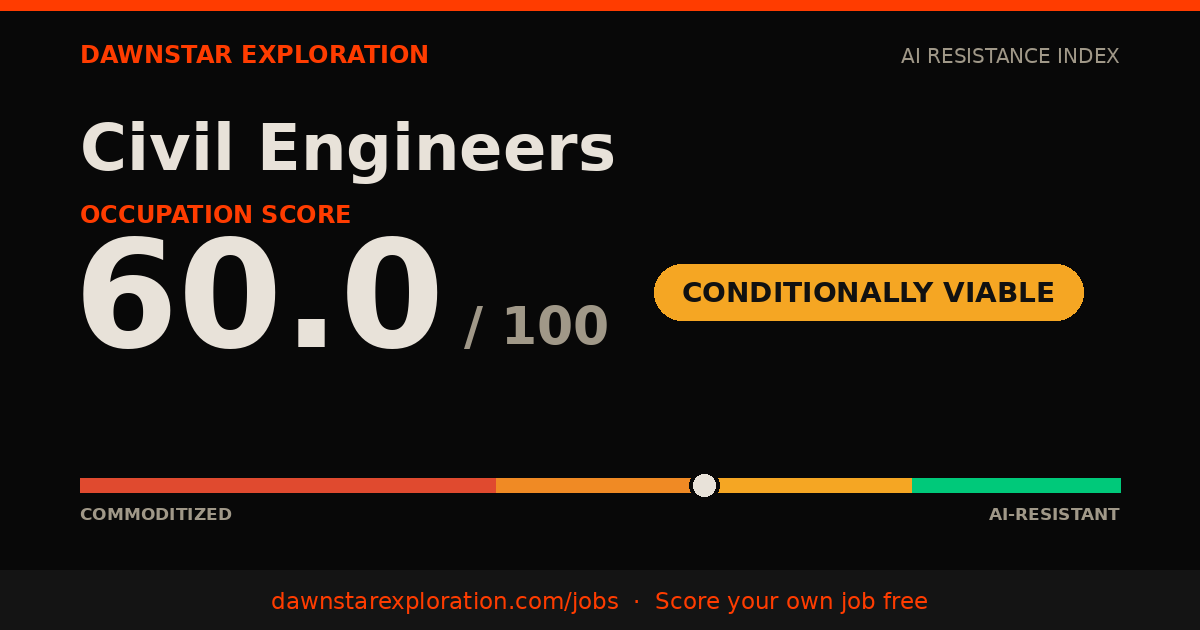
Not the licensed core of it. Civil engineering scores 60.0/100 on the AI Resistance Index (Conditionally Viable): AI and design software already speed up drafting, routine calculations and cost estimates, but a licensed engineer still has to sign off on plans, answer for public safety and deal with real sites, soil and permits.
Higher is safer. Scored on six structural dimensions, weighted as shown below.
How the score breaks down
Each dimension is rated 1 (AI holds every advantage) to 5 (strong structural protection). A rating's contribution is (rating − 1) ÷ 4 × weight, so a 1 contributes nothing and a 5 contributes the full weight.
| Dimension | Weight | Rating | Points |
|---|---|---|---|
| Automation Replaceability | 25% | 3 / 5 | 12.5 |
| Regulatory & Liability Friction | 20% | 4 / 5 | 15 |
| Human Judgment Density | 15% | 4 / 5 | 11.25 |
| Physical-World Coupling | 15% | 4 / 5 | 11.25 |
| Trust & Relationship Lock-In | 15% | 3 / 5 | 7.5 |
| AI Capital Intensity | 10% | 2 / 5 | 2.5 |
| Total | 100% | 60.0 |
Points are exact; the scoring engine rounds the total to one decimal.
Why each dimension scores the way it does
Rated 3. Drafting, routine calculations, quantity take-offs and cost estimates are increasingly automated by design software and AI tools, and BLS lists computer-aided design work among the core duties. Judging a site, choosing between designs and confirming that a plan works on the ground are much harder to hand over.
Rated 4. A Professional Engineer (PE) licence is needed to approve design plans, sign off on projects and offer services directly to the public, and the engineer who signs answers for public safety. Permits and code compliance, which BLS lists among the duties, add further friction.
Rated 4. Analyzing soil and material test results, weighing cost against safety and durability, and deciding how a design responds to one particular site are judgment calls with consequences that last for decades. Software informs those decisions; it does not make them.
Rated 4. Civil engineers oversee surveying, site layout and construction, and assess existing roads, bridges and water systems. Much design work happens at a desk, but the job is tied to physical sites and structures that someone has to see and check.
Rated 3. Public agencies and developers tend to return to engineers and firms with a track record on similar projects. Many contracts are competitively bid, though, which limits how much any one relationship protects the work. Firms that know an agency's standards and systems often win repeat work for that reason.
Rated 2, the weakest dimension. Design and analysis software, increasingly with AI built in, is available to firms of every size at modest cost. The price of the tools is not what protects this work; licensing and responsibility for real sites are.
Which tasks AI takes first
BLS describes the core duties of civil engineers. Sorted by how exposed each is to AI today:
Most exposed to AI
- Drafting plans and drawings in design software
- Routine structural, hydraulic and traffic calculations
- Quantity take-offs and cost estimates
- Compiling reports and permit documentation
Most durable
- Signing off on designs as the licensed engineer
- Assessing sites, soil and existing structures in person
- Choosing between designs on safety, cost and durability
- Working with agencies, contractors and the public
The labor market today
| Median annual pay (May 2025) | $100,840 |
| Jobs (2025) | 380,600 |
| Projected growth, 2025–35 | +6% |
| Openings per year, on average | ≈22,700 |
| Typical entry-level education | Bachelor's degree |
BLS projects 6% growth for civil engineers from 2025 to 2035, faster than average, an increase of about 24,500 jobs. A licence is not required at entry level, but engineers who provide services directly to the public typically must be licensed. The BLS outlook does not discuss AI.
Demand and resistance point the same way here: infrastructure work keeps coming, and the licensed, site-bound part of the job is hard to automate. The score of 60.0 reflects that the drafting and calculation work around it is not.
How to raise your resistance
- Get the PE licence. Signing authority is the strongest protection in this job. Engineers who can approve and stamp plans hold the part of the work AI cannot take.
- Spend time in the field. Site assessment, inspection and construction oversight tie your work to the physical world and to decisions someone must be accountable for.
- Let software do the drafting. Use AI and design tools for drawings, calculations and estimates, and spend the time saved on design decisions and client work.
- Specialize where failure is costly. Bridges, water systems, geotechnical and seismic work raise both the judgment and the liability involved.
This score rates the occupation as a whole. Your exposure depends on what you actually do all day. The free Job Safety score asks about your specific role and day-to-day work, then rates your role on the same six dimensions in about a minute.
Score my job — freeQuestions people ask
Will AI replace civil engineers?
Not the licensed, site-bound core of the job. AI speeds up drafting, calculations and estimates, but a licensed engineer still signs off on designs and answers for public safety. Civil engineers score 60.0/100.
Is civil engineering a good career for the future?
BLS projects 6% growth from 2025 to 2035, faster than average, with a median pay of $100,840 in May 2025 and about 22,700 openings a year.
Which civil engineering tasks are most exposed to AI?
Drafting, routine calculations and cost estimates. They follow established methods that design software already automates, while sign-off and site work do not, which is why automation replaceability rates 3 of 5.
Use this score on your site
Writing about this job and AI? You're welcome to show this score card. Copy the code below: it displays the card and credits the source.
Compare with
Sources and method
Ratings are Dawnstar Exploration's structural assessment using the six-dimension AI Resistance Index framework; labor-market figures are quoted from the sources above as published. This page describes an occupation, not any individual.